|
An island with heart
Por: Vivian Newman Pont | June 15, 2023
They’re just “daring” kids, as the ombudsman once called them, recognizing their great drive at a young age. Five young people in their twenties and a couple who are barely over thirty make up the board of directors of the Orika Community Council (although the real name is Community Council of Black Communities of the Rural Community Government Unit of the Rosario Islands – Hamlet of Orika). They were elected to represent 300 families. They laugh, mock themselves, and dance champeta. But when it comes to moving the community forward, they get serious and don’t stop. With no mayor or police, through alliances, dedication, and passion, Orika and its board have achieved a momentous first collective land title in the Caribbean, running water, and solar panels and continue to seek solutions for the problems of properties and low-water areas.
The ancient and recent history
At the same time that slavery was abolished in Nueva Granada in 1851, five former slaves bought seven “caballerías” of Barú lands—of mangroves and with plagues—from Manuel González Brieva. But they did not want to become individual owners of what is equivalent to about 3000 hectares today. They left a record that the purchase was collective for all families. And so it has been for more than one hundred and seventy years in this space where the community lives, plants, fishes, and dances.
Over time, the land and the community have suffered many setbacks. The coconut production they lived on was hit by a plague known as “porroca.” Then fishing decreased due to dynamite and the extraction of very small fish, while the coral reef deteriorated due to warming, contaminated water from the Dique Canal, and hotel septic ponds. Finally, and out of pure necessity, some community members sold what they could not sell and became caregivers and cooks for their buyers.
This is how we arrived at the recent history in which two members of a previous generation led the recovery of what they seemed to be losing. On the one hand, Ever de la Rosa, a former representative of the Orika Council, promoted at the beginning of the 2000s the clearing of the bush to create a settlement that allowed the rescue not only of the territory but also of the culture that unites them as a group and that was dormant on the deeds that protected collective property. On the other hand, Lavinia Fiori, a native adopted by the community, has navigated this settlement, pushing and supporting environmental sustainability and restoration through the institutional tangle. Both, with the support of Dejusticia and the University of the Andes, promoted a tortuous and momentous legal process before the Constitutional Court that in 2012 recognized, for the first time in Colombia, the collective title of an Afro community in the Colombian Caribbean Islands. Along with the territory that had collectively belonged to them since slavery, their culture and the ancestral bond of these families who always have lunch for whoever shows up at noon were protected. They managed to get Law 70 on ancestral collective titles not just to be a piece of paper but to be installed on the island. They also managed, says Lavinia, for Parks not only to protect the reefs and mangroves but also the ancestral practices of the Black communities, such as fishing and tourism. In short, they managed to be the owners of their land and their destiny. A phrase that, in addition to sounding nice, is materialized by the number of businesses that are now native-owned and where they work as owners, not as laborers. And thus, they are opening the door to other Afro community councils in the country.
Today’s history

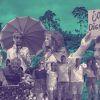
They summon tourism operators and know everyone who lives and rents on the island. They are the best caretakers of this common good.
Photo: Tina Neumann
Let’s go back to our group of young native champeteros who act as spokespersons for the community. Their contributions, as well as their concerns, focus on the expansion of collective titling and the organization of the maritory. There are several threats derived not only from global warming but also from the negligence of the institutions, which, when they are not doing tourism and property rental projects that affect the neighborhood, simply ignore the island. Consequently, this group has had to play a leadership role to promote coexistence and territorial planning. They summon tourism operators and know everyone who lives and rents on the island. They are the best caretakers of this common good. And they do not ask that the tourism companies that are in the area be removed, but that the collective titling be a tool to prevent forced displacement to Cartagena, the loss of their property, and their collective identity. Dayana Medrano, born in Caño Ratón to a mother who had eight other children, took on the vital challenge of moving away from the early pregnancy and permanent childbirth she had seen in her home, to run as a representative of the Orika Council. She studied law with a scholarship. She filed a tutela that she accompanied with a stir of newspapers, radio, and social networks for two months, to achieve a health post that today shines in Orika. And now, with a great dose of pride, pocketed in a pair of shorts and a lush mane, she looks me straight in the eye and tells me that she loves the island and that she will do everything for it. All the achievements are little next to the plans of this community.
“How are you, my heart?”… Dayana interrupts our conversation to greet a young man who passes by… And I reply that the heart of this island, thanks to the Orika community, has taken a 180-degree turn, and it sounds as healthy and indispensable as the beat in the champeta of the Palenquero Charles King.

It has been achieved that Law 70, on ancestral collective titles, was not a paper but was installed on the island.
Photo: Tina Neumann
(*) Associate researcher at Dejusticia
(**) This article is part of the special #TejidoVivo, a product of a journalistic alliance between the Dejusticia study center and El Espectador.