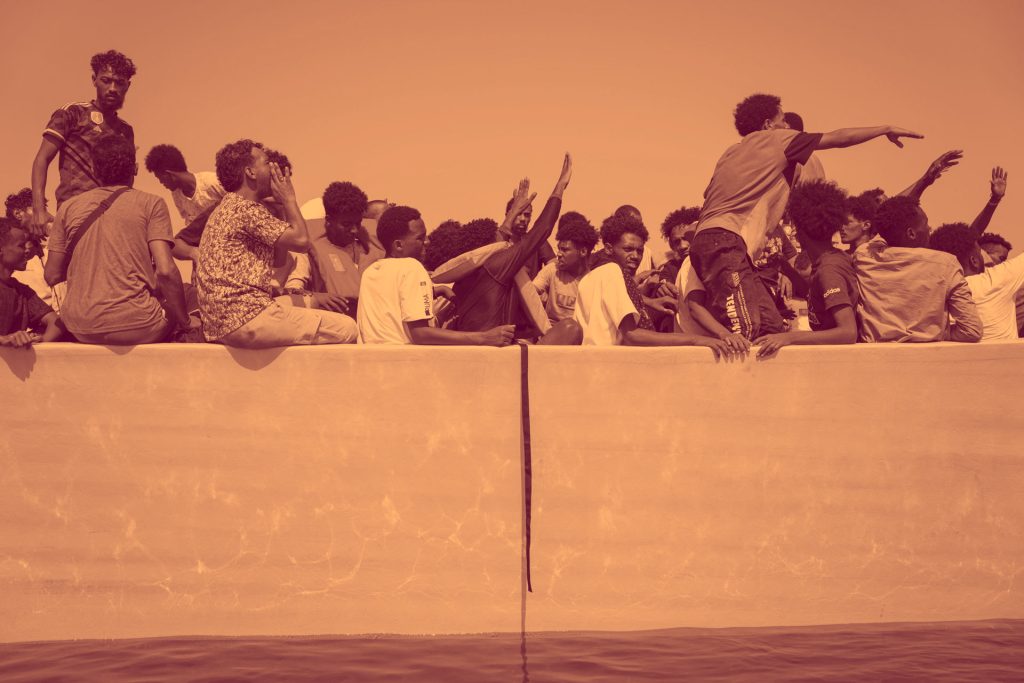
| EFE
Human mobility under threat: How is Latin America responding?
Por: Lina Arroyave, Christy Crouse | September 1, 2025
On February 15, 2025, the last of three flights carrying migrants expelled by the United States under an accelerated deportation scheme landed in Panama City. In just four days, 299 people from countries as diverse as Cameroon, Haiti, Venezuela, Nepal, and Angola were transferred. None of them had any ties to Panama, beyond the fact that they had been sent there by decision of another state.
The images spread quickly: women, men, children, and elderly people were taken to the Decápolis hotel without their belongings or documents, held incommunicado and under the surveillance of the Panamanian state. Many of these people were later sent to a Migration Reception Center in Darién, where they remained in detention. Under pressure from social organizations and legal action before the IACHR, the Panamanian authorities offered a limited response: they released the detainees, returned their phones, and granted them temporary residence permits for 30 days, extendable to 90. But with an implicit warning: that time should be used to leave the country, either by returning to their country of origin or seeking another destination.
This was not an isolated case. It reflects a migration governance system built on an architecture of migration control based on containment, punishment, and the denial of rights. Migrants face not only physical borders, but also legal, institutional, and cultural barriers: obstacles to accessing refuge or regularization, institutional discrimination, barriers to accessing basic services, and a constant presumption of criminality based on their nationality and documents. They are often treated as threats, not as subjects of rights.
Under these circumstances, how can Latin America respond to policies from the Global North that exacerbate inequalities, undermine cooperation, and reduce migration to a matter of security and control? The region has tried different responses, from reception policies and regularization processes that marked a regional shift, to support networks led by civil society. However, many of these initiatives are now facing setbacks and challenges in a regional context increasingly pressured by securitization.
This blog analyzes how, despite these tensions, Latin America can strengthen and sustain rights-based responses in a global scenario that pushes in the opposite direction.
Between containment and criminalization: barriers to guaranteeing migrants’ rights
Today, the ways governments approach migration prioritize control over protection. In the case of the United States, immigration policy has historically been complex and has undergone various securitization processes, especially since the attacks of 9/11. This logic has intensified significantly under Donald Trump’s second administration, which began in January 2025 and has promoted a punitive, stigmatizing approach focused on externalizing control. Between January and April of this year, 142 executive orders and proclamations have been issued, at least 40 of which are related to immigration. These measures are not limited to the domestic sphere: they extend to Latin America through bilateral agreements that transfer immigration control to other countries.
These practices contradict the commitments made by Latin American states and negatively affect migrants and refugees. The Cartagena Declaration on Refugees—which broadens the notion of international protection in contexts of violence and massive rights violations—has been ignored. The Global Compact for Migration, although not binding, has been emptied of content and used to prioritize control over cooperation. Even more seriously, binding norms such as the 1951 Convention Relating to the Status of Refugees, the American Convention on Human Rights, and other international instruments, which enshrine the principle of non-refoulement and establish the obligation to guarantee, without discrimination, fundamental rights such as personal freedom, judicial protection, physical integrity, and due process, are being violated.
The case of Panama, like others in Mexico or El Salvador, reveals how the criminalization of mobility erodes human rights and causes harm to migrants and their lives. Multilateral discourse persists, but in practice, governance focused on containment, suspicion, detention, and expulsion prevails.
Externalization, securitization of migration control
For decades, but with renewed emphasis in recent years, the United States has deepened two complementary strategies: the securitization and externalization of migration control. On the one hand, securitization involves treating migration as a threat to national security. This translates into the use of security forces to control borders, surveillance technologies, and measures that impose barriers to accessing refuge. Externalization, on the other hand, consists of transferring immigration management to third countries. Through bilateral agreements, which are often opaque, the United States finances containment measures and trains immigration management bodies in Latin American countries to curb migration flows before they reach its territory.
A recent example is the Safe Mobility Program (2023–2024), promoted by the United States, with offices in Costa Rica, Colombia, Ecuador, and Guatemala. The program offered to process asylum applications from those countries. Colombia became a testing ground for this strategy: it was the country with the most applications and people processed. Although the initiative promised a faster way to process the resettlement of asylum seekers and provide information on pathways to regularization in the United States, it was inaccessible and obscure. Many people did not know how to apply or what the status of their application was. The agreement between Colombia and the United States was never published, which made it difficult to publicly monitor its implementation. When the program was closed after the November 2024 elections, the lack of accountability became evident: responsibilities had been outsourced, and no state has responded to the needs of migrants and asylum seekers or to requests for information from civil society.
These trends confirm a worrying reality: effective international protection mechanisms are being weakened or replaced by control models. Even when regularization programs are created, they tend to be temporary, restrictive, and inaccessible.
From containment to protection: responses that put people and their rights at the center
Despite this outlook, Latin America is a space of resistance and proposal. For decades, several countries have promoted more open and protective international mobility and protection policies based on the free movement of people and regional cooperation. Today more than ever, they must resist pressure to replicate security-based models and reaffirm rights-centered approaches.
Migrants, refugees, organized communities, and rights defenders are building alternatives. In response to the reversal of migration flows—with people returning to the south due to new restrictions in the north—solidarity networks have emerged that seek to protect and accompany them. For example, one network that has recently expanded consists of organizations from across the Americas that monitor and denounce the use of technology to surveil and limit the right to move and migrate. Another example is a group of civil society organizations in Central and South America that share news about migration policy and management in real time and from their countries so that everyone can stay informed. Humanitarian and human rights organizations are adjusting their strategies to respond to new forms of institutional violence.
Today, in the face of the advance of containment policies imposed from the North, the South is not only resisting: it is proposing alternatives. Through litigation, support networks, community processes, and regional spaces, responses are being developed that prioritize rights, challenge the criminalization of human mobility, and uphold the possibility of dignified and protected migration. It is not an easy path, but it is urgent and possible.
It is not just a matter of surviving this threat to human mobility, but of addressing it politically. The South can and must articulate ethical and transformative responses to the securitized and externalized policies of the North. We must move from a focus on control to protection, from criminalization to the guarantee of rights. We must continue to insist that migration is a right; human movement is not a problem to be solved, but a reality to be understood and protected.