


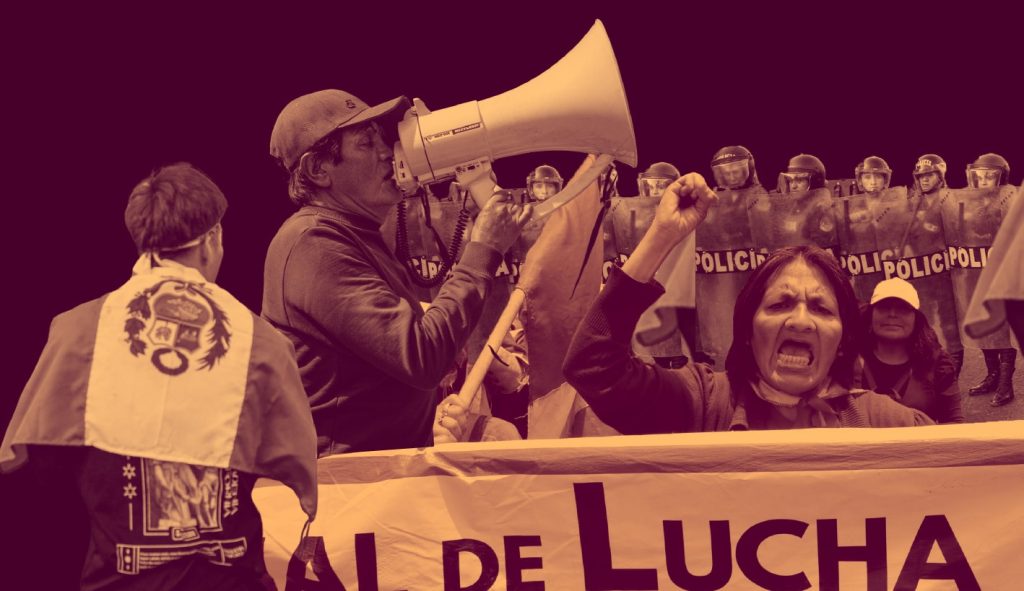
In Peru and Latin America, protecting civic space is essential to strengthening democracy and ensuring that the most vulnerable voices are heard. |
The right to protest under threat: the situation in Peru
Por: Sofia Forero Alba, Betsy Zavaleta Amaya | March 6, 2025
Peru carries wounds that never fully healed. The scars of the internal armed conflict and the Fujimori dictatorship have left a shaky democracy, plagued by distrust and disillusionment. These wounds, which seemed to have been relegated to the past, continue to beat strongly in every repressed protest, in every delegitimized march, in every act of resistance that is branded as subversion. Since 2016, the crisis the country is going through has been evident: six presidents, three congresses, and a constant struggle for power have blurred the foundations of an already fragile institutional framework.
The current government of Boluarte represents the climax of this crisis. Her administration is perceived as the result of years of corruption, repression, and criminalization. Since her rise to power in December 2022, following the impeachment of President Castillo, Peru has experienced an unprecedented escalation of social tension. The massive protests demanding new elections, justice, and structural change were repressed: more than 60 deaths, thousands injured, hundreds of people criminalized and a country divided between those who demand justice and those who justify repression in the name of order.
Cruz, a human rights lawyer from Sin Fronteras, with whom we spoke for this blog, points out that this crisis is cumulative and not exclusive to the current government. Since the end of the Fujimori dictatorship, Peru has oscillated between various failed paths of reconstruction. The decision to build a state on the basis of this dictatorship’s Constitution has perpetuated inequalities and conflicts, while the setbacks in collective rights show the State’s inability to address structural problems.
Why is it important to guarantee the right to protest?
The right to social protest consists of “a form of individual or collective action aimed at expressing ideas, visions, or values of dissent, opposition, denunciation, or claim,” according to the Special Rapporteurship for Freedom of Expression-RELE of the Inter-American Commission on Human Rights. The political constitutions of Latin American countries have incorporated the protection of this right within their internal legal systems, and although in the case of some countries this right is not explicit, we can deduce it from their jurisprudence.
According to Lalinde in In Praise of Noise (2019), the right to protest constitutes an essential pillar of democratic societies, ensuring that historically excluded groups from decision-making, such as women, indigenous peoples, LGBTQ+ people, among others, have guarantees to raise their voices. This right strengthens citizen participation and promotes the construction of more inclusive societies that are respectful of the diversity of opinions.
However, this recognition at the normative level has not been enough to protect the exercise of the right to social protest in practice and its relationship with the exercise of other rights such as freedom of expression, the right to life and personal integrity, or equality and non-discrimination.
Criminalization against indigenous and peasant people: the case of the young people of Cusco
In December 2022, multiple protests took place due to the political crisis. In the Cusco region, as in other parts of the country, thousands of people took to the streets. Young people, many of them from peasant and indigenous communities, were a key part of these mobilizations, and they also became the target of violent repression by law enforcement.
Richard Camala, Ferdinán Huaccanqui, Redy Huamán and Joel Hivallanca, four young people from the district of Pisac, province of Calca, department of Cusco, all from the Peasant Community of Cuyo Grande, joined the demonstrations. On January 31, 2023, they were arrested and accused of committing the crimes of disturbing the peace and obstructing the functioning of public services, despite there not being enough evidence to directly link them. They were sentenced to prison for six to seven years, along with a significant civil reparation ($21,585.00 US dollars). The criminalization of these young people became an emblematic case of how social protests, especially those led by indigenous and peasant communities, are brutally repressed.
Vera, a lawyer for “Human Rights Without Borders,” who have accompanied the judicial process, indicates that said process has been full of irregularities since the arrest and that, furthermore, the imputed crimes and the sentence are absolutely disproportionate. In his words, “this sentence is plagued with nullity.” In fact, the young people pleaded guilty, due to poor advice from those who were their legal defense at the time, who assured them that this would allow them to be released. However, this did not happen and in the end they were convicted without the evidence being verified.
This case, in addition to showing how the Peruvian State has been strengthening strategies to criminalize social protest, also reflects a deep problem of structural racism, where indigenous and peasant communities, historically marginalized, face double stigmatization: for their ethnic origin and for their political activism. The institutional violence against these young people highlights the social and political exclusion they suffer in a country that continues to drag strong inequalities. The disproportionate action by the public force is reflected both in the repression of the protest, and in its subsequent criminalization.
In the process, the young people of Cusco were treated without an intercultural approach, although they belong to a peasant and indigenous community. For example, there was no Quechua interpreter despite this being the native language of the young people. In Vera’s words, “they did not get along very well in Spanish, they spoke very little, it was more in Quechua. This is a fundamental right, that they be judged within their native language that they handle and even more so if they are going to recognize responsibility and have the consequences of the responsibility they are accepting explained to them.”
In addition, the money they have been forced to pay disregards their socioeconomic circumstances. In the same vein, Vera maintains that “this civil reparation is totally disproportionate, for them who cannot save money because they do not engage in commerce, but in cultivating the land, their products, in agriculture, mainly.”
Law No. 32183, the “security” excuse to criminalize protest
Cases like that of the young people of Cusco are not isolated; on the contrary, they reflect a constant throughout the country, where social and political fractures are intertwined with a growing sense of citizen insecurity. In this context, far from implementing effective public policies against insecurity, the State has chosen to instrumentalize this problem. Using the pretext of security, it has intensified the criminalization of protest, a strategy that aligns with trends observed in other governments with authoritarian leanings. With the promulgation of Law No. 32183 of November 2024, what was previously said is evidenced. Its wording dangerously leaves open the possibility that acts of protest, such as blocking roads or occupying public spaces, may be considered extortion. In addition, it prevents officials from joining strikes in other sectors, indicating that they will not be able to continue in office.
Let’s imagine a common scenario: peasants and indigenous people block a road, not on a whim, but because decisions made in Lima have ignored their needs. With this law, these acts would be extortion. This approach not only stigmatizes social protest, but also builds a wall between the State and its citizens, treating legitimate demands that are collectively claimed in the public space as threats to order.
This law institutionalizes this type of injustice. More than protecting public order, it reinforces a system that seeks to demobilize the most vulnerable sectors. In a country where approximately 60% of protests are linked to socio-environmental conflicts and these mostly take place in peasant and indigenous communities, it is a tool to silence the demands of those who see their territories threatened and their rights trampled.
Cruz highlights that this proposal does not respond to a lack of legislation against insecurity, since the existing legal framework is sufficient. Instead, the initiative seems to aim to restrict rights within the framework of social protest.
Closing of civic space and the danger for democracy
The law and the case of the young people of Cusco are examples of how the criminalization of protest limits citizen participation. What does this mean for Peruvian democracy? It means that the State not only represses, but also legislates against the exercise of fundamental rights. It also means that protest ceases to be seen as a pillar of democracy and becomes a threat that must be contained. In recent months, Peru has no longer had massive nationwide protests, however, there are protests with a regional context that are still in danger due to the closing of spaces.
In Peru and Latin America, the protection of civic space is essential to strengthen democracy and ensure that the most vulnerable voices, often from historically marginalized communities, are heard without fear of retaliation. Therefore, it is essential that not only the right to protest, but all fundamental rights and freedoms, be respected and protected. Democracy flourishes with respect for the diversity of opinions and the guarantee of human rights, not with the repression and criminalization of those who raise their voices in search of political and social transformation.


