


Issue-Rule of Law
Judges, elections and post-truth
If the policy of post-truth is a threat to democracy as I argued in my last op-ed, a question arises: would the solution be that judges revoke electoral victories based on lies?
Read MoreOf espionage and bullying
Two intelligence reports that entangle Donald Trump with the Russians have just been published: the Russian hacking against Hillary Clinton and the espionage against Trump from the Kremlin. Both reports have different origins and credibility, but once again, they reflect the black clouds threatening the neighborhood.
Read MoreHow to move forward in the Access to Information Movement
I have learned that at some point, the human rights perspective is not enough to push the right forward. Instead, the time has come to collaborate more closely with tech-oriented background actors, such as the Open Government Data Movement.
Read MoreDemocracy and “post-truth”

The Oxford dictionaries chose “post-truth” as the 2016 word to emphasize that objective facts and the truth had become less important in the political discussion and elections than the so called appeals to emotions and personal beliefs.
Read MoreThe good judge Brandeis
Let’s pretend that it is 2025 and we can already scan brains to know, for instance, if their owners have been trained by ISIS.
Read MoreWhite collar corruption
This year began with serious corruption news in soccer, in Petrobras and in the food supply of La Guajira. With the passing of months, things did not change.
Read MoreCensorship, a new ingredient in the sugary drinks debate?

Through a tutela initiative, citizens want that the television commercial on the possible health effects of sugary drinks that the Industry and Commerce Oversight Office prohibited is played again.
Read MoreTo say without saying
Documentaries are a dialogue with reality, both in what they say and show as well as in what they keep silent.
Read MoreThe empty land déjà vu: The Constitutional Court can prevent us from going back a decade
“An important proportion of the large concessions of empty land between 1849-1872 was for cinchona bark extraction (…) Among the bark sellers that obtained concessions on empty land, there were people who had significant fortunes, and other that had been State high officials or had links to government. Among them were also investors and foreigners. Other export products had a similar weight such as tobacco, rubber, indigo plans, and coffee (…)”
Read MoreEviction of the peace camp broke regional, national, and international laws
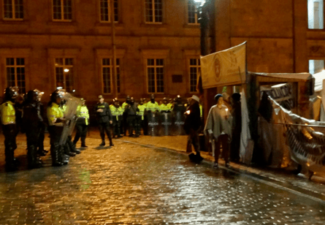
Our lawyer Anna Joseph
wrote a blog for the Huffington Post on the eviction of the peace camp in
Bogota, explaining the numerous national and international laws that were not
respected during the dismantlement. The blog was published in Spanish by Las 2
Orillas.
Many dummies and few organized crime barons
During the discussion of the new Penitentiary Code, the two most talked about problems of the penal system have been the impunity and overpopulation in prisons. A recent study carried out by Dejusticia shows that these two issues might be related and that strategies exist to overcome them jointly: the efforts of the criminal policy must be addressed to research and sanction what is most grave.
Read MoreMilitary criminal justice jurisdiction: the reform’s threats
Until now the military is the winner of a imaginary legal war, which generates risks for civil society and the aftermath of the conflict. The attempts to guarantee independence and impartiality of military justice are insufficient to address these risks.
Read MoreThe crisis of justice in Colombia
Some months ago, when the discussion about the failed “justice reform” initiated, the constitutionalist Rodrigo Uprimny said: “The Colombian justice is ambiguous and paradoxical. Neither it is excellent nor it is collapsed. It has things that work well, but others are terrible”
Read More