I don’t care if they call me a dictator.
Dejusticia August 15, 2025
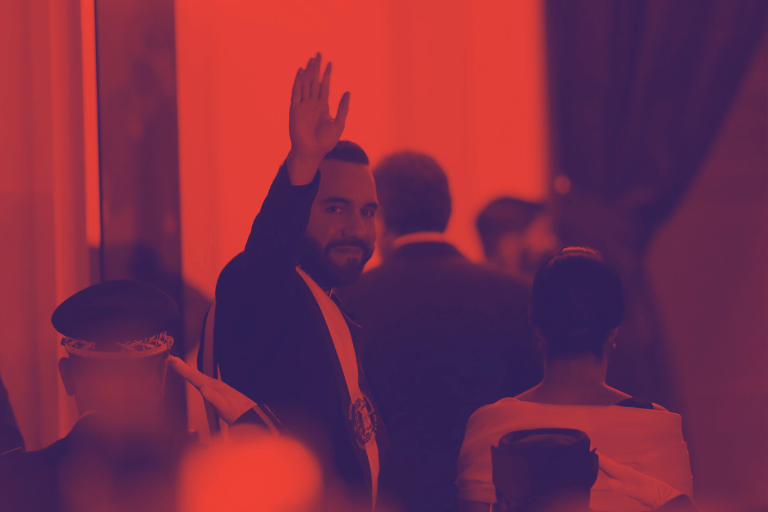
Nayib Bukele, president of El Salvador, was re-elected in 2024. |

During his six years in office, Bukele has consolidated his power, paving the way to become the dictator he appears to be announcing himself as.
During his six years in office, Bukele has consolidated his power, paving the way to become the dictator he appears to be announcing himself as.
“I don’t care if they call me a dictator,” said Nayib Bukele, president of El Salvador, last June in one of his annual speeches at the National Theater, in front of hundreds of Salvadorans.
During these 6 years in the Presidency, Bukele has consolidated his power, paving the way to become the dictator he apparently claims to be. There is no shame or doubt in his statement, because his popularity allows him to be a wolf dressed as a wolf.
His presidential career is short but forceful. He came to power by popular election in 2019. In 2021, the Legislative Assembly (which he majority controls), dismissed all the members of the Constitutional Chamber of the Supreme Court, the equivalent of our Constitutional Court, and appointed officials affiliated with his government. Months later, this new Supreme Court declared Bukele’s immediate re-election constitutional, and in 2024 he was re-elected.
You might be interested in: Bukele: the savior?
In addition, last June 2025, the Legislative Assembly approved the Foreign Agents Law. With this law, the government decides which human rights organizations can work in El Salvador and imposes a 30% tax on them. These measures point to the weakening of civil society and the freedoms of expression and association.
Finally, last July 31, in an express procedure of a couple of hours, the Assembly reformed the Constitution (a process that in Colombia requires eight debates in Congress, equivalent to approximately one year). There, among other measures, it declared indefinite presidential re-election constitutional, extended the presidential term from five to six years, and eliminated the second electoral round.
This story of democratic erosion in El Salvador coincides with the V-Dem Democracy Report 2025. El Salvador is no longer an electoral democracy, but an ‘electoral autocracy’ along with countries like Ethiopia, India, and Pakistan. This means that there is a democratic decline where freedom of expression and association, and the holding of free and fair elections, are insufficient.
Some will say that in El Salvador one can now live, since gang criminality has decreased, and that is more important than any democratic system. But, what is lost when democracy is lost? You don’t have to look too far to find the answer. Venezuela, under Nicolás Maduro, and Nicaragua, under Daniel Ortega, show how power without limits leads to corruption, disappearances, political persecution, and arbitrary imprisonments in which innocent people who could be people like you or me fall. The latest Human Rights Watch report points out that since March 2022, El Salvador has been under a state of exception in which, without due process guarantees, more than 86,000 people have been detained, including more than 3,000 children. Various reports indicate that detainees are crowded into prisons where they receive cruel and inhuman treatment.
This year presidential elections are coming up in Bolivia, Chile, and Honduras, and in 2026 in Peru, Costa Rica, and Colombia. The tendencies towards authoritarianism are in the air in these countries and could lead to regimes like Bukele’s. It could also be an opportunity for the candidates who propose democratic models that guarantee our fundamental rights, to also include the issue of security, among others, in their pillars. So that we don’t fall into Bukele’s trap, in which he falsely shows that security and democracy are two incompatible issues.