


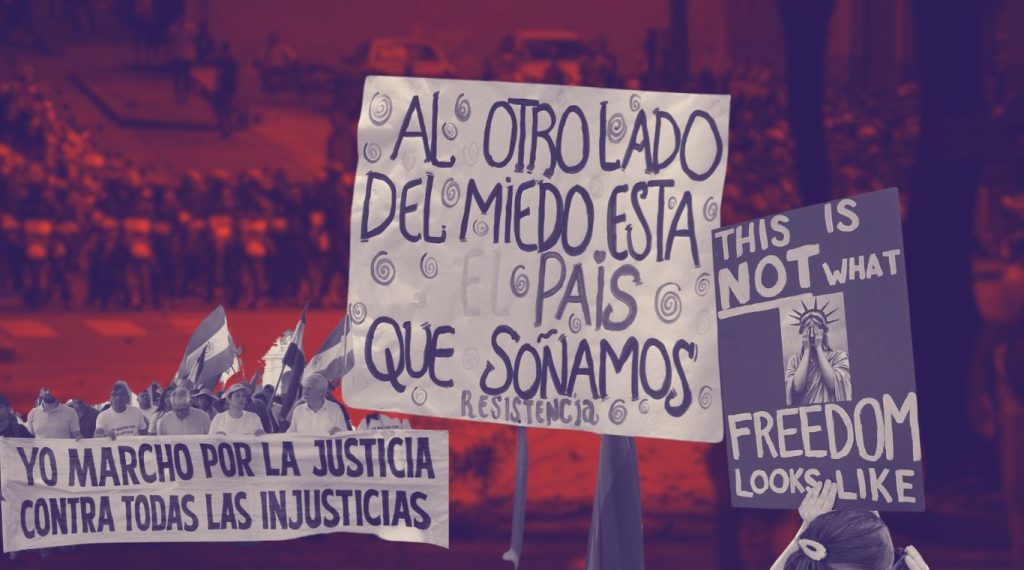
In Latin America, civil society faces criminalization, funding cuts, and censorship. There is an urgent need to reinvent collective solidarity networks in order to resist. |
Let’s imagine with others to address the crisis of civil society in Latin America
Por: Dejusticia | May 31, 2025
Civic space is shrinking in Latin America. Governments restrict freedoms, make accusations without evidence, and criminalize protest; they monitor communications and cut funding. Human rights organizations face digital and legal censorship. That’s why we must innovate our support networks to survive.
Today we see democratic setbacks: in Venezuela, populism with open repression; in Peru and El Salvador, governments that limit freedoms and erode checks and balances; even in the U.S., weakened institutional controls and fundamental rights.
An international gathering to navigate the challenges of civil society
The current context demands that we improve our structures to find new ways of survival, resistance, and solidarity. We believe that through dialogue, the exchange of experiences, and alliances, we can resist this crisis from different territories.
At Dejusticia, we organized an international gathering held in Bogotá from June 3 to 5. We called this space “Imagining with Others,” because our goal was precisely to bring together various key actors to explore innovative strategies that allow us to confront the closing of civic space.
This gathering brought together 20 Peruvian organizations that are part of our Enlaza Strengthening Program. We also welcomed guests from Colombia, Nicaragua, Venezuela, Russia, Hungary, and the United States, who shared their experiences and lessons learned in their countries for navigating the authoritarian challenges we face.
The agenda addressed six key topics and how to handle them in times of crisis:
- Closing of civic space
- International advocacy
- Communications
- Financial sustainability
- Survival under anti-NGO laws
- Strategic alliances
Enlaza: our commitment to strengthening civil society
Since 2022, Dejusticia has implemented the Enlaza Strengthening Program. This program promotes both mission-related and administrative capacities tailored to each organization.
Our mission is to design flexible strategies that adapt to diverse contexts according to specific needs. That’s why one of the pillars of our approach is direct organizational strengthening, in which Dejusticia’s teams and our civil society partners work together, semiannually or annually, with social organizations on topics such as communications, strategic litigation, research methodologies, peace, gender, sexual diversity, and ethnic-racial rights, among others.
We also provide collective strengthening through regional and international workshops that bring together organizations from different contexts around shared needs in social and environmental justice. The topics of these gatherings are chosen by the organizations themselves, ensuring they respond to their real challenges.
In 2024, we held four regional workshops and two international ones, with the participation of over 100 Colombian and Venezuelan civil society organizations, on topics such as climate litigation, peasant reserve zones, harmonization between indigenous and ordinary justice in cases involving ethnic peoples, advocacy before the International Criminal Court, and the role of journalism in the face of shrinking civic space, among others.
Another key pillar of our work is strengthening the collective voice. We do this through journalistic work and publications to amplify these organizations’ voices and highlight their enormous contributions to our rights and democracy. This not only strengthens our presence in public opinion, but also helps counter negative narratives aimed at delegitimizing our work.
One example is the work we carried out in 2023, publishing 32 articles in the Colombian newspaper El Espectador as part of a special series called “Tejido Vivo” (“Living Fabric”), which, one year later, we transformed into a book published by Angosta Publishing and launched at the Bogotá Book Fair.
How to survive resource scarcity?
Economic sustainability is a critical challenge. Access to funding and resource diversification ensure the continuity of social work. Without it, many initiatives become vulnerable.
In response to this challenge, through the Enlaza Strengthening Program and together with various partners, we promote connections with other actors for future funding, facilitating spaces for meetings between organizations and potential strategic allies such as foundations, cooperation agencies, universities, and companies. These connections aim to create opportunities for funding, technical assistance, and collaboration that strengthen organizations’ long-term sustainability.
In short, our Enlaza Strengthening Program sets forth a clear goal: for social organizations and the human rights movement to strengthen their internal and external capacities. This will allow us to face economic crises, widespread inequality, increasingly restricted civic spaces, and various forms of authoritarianism—challenges that threaten both our survival and our ability to influence social policies that can change realities in our territories.
Do you want to help boost the Enlaza Strengthening Program?
If you would like to learn more about our Enlaza Strengthening Program, participate, or support its expansion to reach more organizations, you can write to the coordinator Nina Chaparro (nchaparro@dejusticia.org). Your collaboration is key to strengthening the human rights movement in the Global South.
