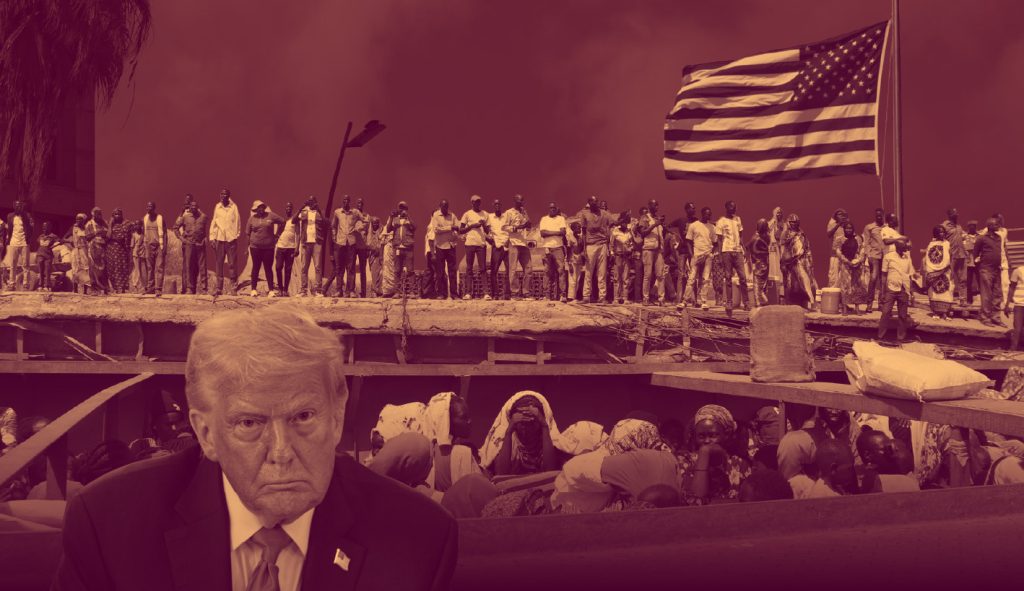
La desfinanciación y desestimación de espacios multilaterales —por Estados Unidos, líderes autoritarios, los superricos— es un reto enorme. |
Reclaiming multilateralism for a shared future
Por: Christy Crouse, Abby Steckel | September 1, 2025
“The whole island seemed to be on fire,” recalls a resident of Providencia Island as Hurricane Iota passed through in 2020, leaving thousands of homes, hospitals, churches, and schools destroyed. On the other side of the world, a migrant from South Sudan seeks to escape political instability, humanitarian crisis, and armed conflict. On his way to Europe, he finds himself barred from passage and rejected in the middle of the Mediterranean Sea. What do the victims of the hurricane and migrants facing a lack of state protection of their human rights have in common?
Part of the tragedy these people face is due to the failures of multilateralism. Although discussions in diplomatic circles about global problems and multiple crises seem distant and even futile, they are vital to achieving collective progress in the face of the global polycrisis. Multilateralism currently faces multiple challenges, but here we will focus on those arising from two actors: the United States and the super-rich. What are these challenges and how do we address them from civil society?
The United States and the super-rich challenge multilateralism
Multilateralism—cooperation and coordination among multiple actors to address common problems and achieve shared goals—is essential to addressing the multiple crises facing the world. One of the most successful cases is the Montreal Protocol, a global agreement signed in 1987 to protect the ozone layer by reducing and eliminating the production and consumption of ozone-depleting substances. A future without multilateral collaboration could have disastrous results for humanity; we want to propose and support a scenario of multilateral collaboration in which humanity manages to deal with global challenges.
Donald Trump’s second presidential term is accentuating the erosion of multilateralism. In his first term as president, Trump distanced the United States from many global causes and several multilateral spaces, such as the Paris Agreement, which is the binding international instrument on climate change. The United States has also withdrawn from other forums, such as the United Nations Human Rights Council, the World Trade Organization, and even, in the midst of the pandemic, the World Health Organization (it has already begun the process of leaving again). This is not to mention the closure of the Agency for International Development (USAID) by Trump and Elon Musk, which cut off essential funding for the work of many local and international organizations. In general, the United States is defunding many multilateral efforts and forums.
Although the United States is a country with equal rights and duties as a member of the United Nations and other similar forums, its disproportionate responsibility for global issues (climate change, inequality, conflicts/weapons, technologies), together with its capacity to finance possible solutions, gives it considerable weight in the global order. The current “America First” policy seeks to end what the government sees as an abusive relationship in which the United States gives a lot and gains little. Furthermore, the executive order to review all commitments to international bodies is based on the assumption that the United States can replicate the capabilities of multilateral organizations and global public goods.
This is unrealistic and will destroy decades of multilateral efforts to combat common challenges. Trump and Musk are not isolated cases, but part of a trend of authoritarian leaders and “super-rich” individuals who share a narrative that despises multilateralism. This is an international oligarchy that seems to view multilateralism as an obstacle to its ambitions.
Super-rich individuals control companies that wield great power over their countries’ foreign policy and decisions in multilateral spaces, such as the United Nations. In Trump’s case, it is no longer simply a matter of the super-rich influencing from the margins of power: now, some of the richest—such as Elon Musk—are actively involved in the design of power. What has changed is not their ability to profit, but the nature of their access.
These individuals usually seek to protect and expand their profits, which translates into maintaining economic inequalities and extractive industries, regardless of the impact on populations and territories. These extremely wealthy people have successfully influenced regulations that favor greenhouse gas-intensive industries, restrict the production of essential medicines in favor of companies that retain their patents, and sell weapons to Israel, despite the atrocities that country continues to commit in Gaza. Although there are international agreements, these are negotiated advantageously by the power of the northern economies over extractive countries that are more likely to accept bribes to regulate in their favor.
It is worth betting on a new model of multilateralism
Multilateral spaces remain important, some more than others. For example, in September 2024, Dejusticia attended the Summit for the Future, a high-level event held at the United Nations headquarters in New York. There, states approved the Pact for the Future, a pact that promotes compliance with the Sustainable Development Goals (SDGs). This Pact and its annexes seek to coordinate and finance solutions to various problems, including wars, technology, sustainable development, and the well-being of future generations. Its objectives are extremely general—it is difficult to imagine that it will be possible to coordinate and achieve the changes it seeks. Even so, the space helped to articulate a common language and some new and important goals for global challenges.
Here we see the importance of multilateral solutions: the causes of these problems and, therefore, the solutions to them are collective in nature, but they are not distributed equitably among countries. That is why spaces such as the Future Summit are essential for negotiating solutions and securing commitments from states to implement them. There are flaws that must be acknowledged in multilateral spaces: failure to respond to problems in a timely manner; failure to reach consensus; lack of effective participation by civil society and the people affected; among others. But even though they have limitations, the fundamental thing is that multilateral spaces continue to exist and that there are mechanisms to follow up on the proposed solutions.
So, what can we in civil society do to safeguard these multilateral efforts, while actors such as Trump threaten them? It is important to recognize key multilateral spaces in order to prioritize and assert their importance before and in conjunction with governments, seeking to ensure their international legitimacy.
One way to do this is to choose to adjust the current model of multilateralism, creating a new model that makes collective bargaining conditions more favorable for the Global South. To this end, civil society must continue to demand ways to actively participate in these spaces, ensuring that its voice reaches decision-makers. Its messages are essential to guide decisions in multilateral spaces in a direction that prioritizes human rights, the well-being of the most vulnerable populations, and social justice. It could also involve a realignment, for example, to create and prioritize certain regional spaces where agreements could be reached more efficiently and promptly (coordination between states to respond to migration, for example).
The victims of Hurricane Iota, migrants seeking protection, and other populations affected by multiple crises around the world deserve protection and support. The defunding and dismissal of multilateral spaces—by the United States, authoritarian leaders, and the super-rich—is a huge challenge. It could be a historic opportunity for the Global South to redefine its role in the global order and reclaim a new model of multilateralism. But without a doubt, we will have to continue insisting on the importance of collaborative and participatory spaces and solutions to secure our future.