


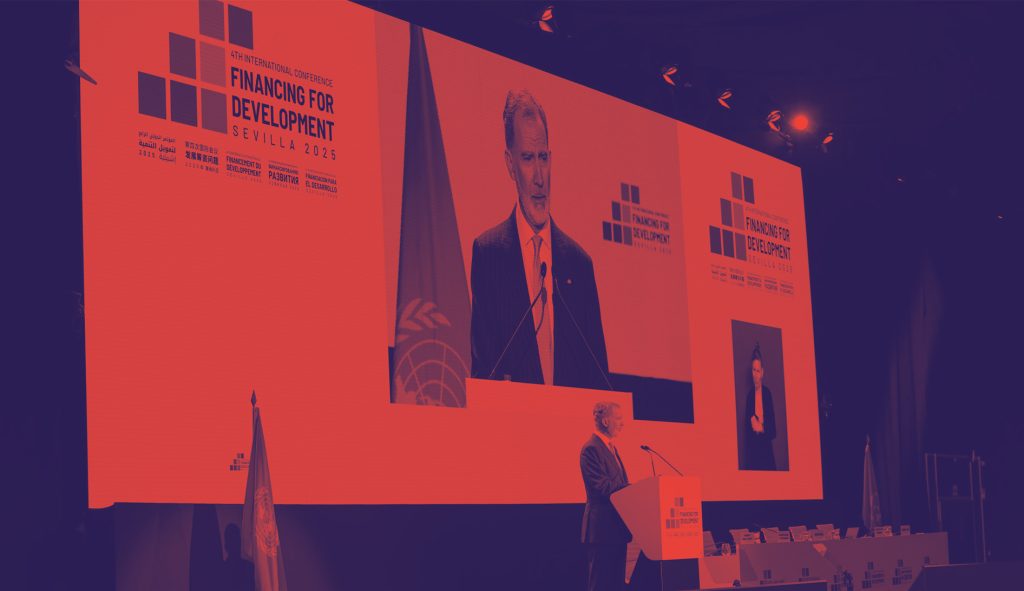
Fourth United Nations International Conference on Financing for Development (FFD4) | EFE
“Seville’s commitment” must not remain on paper
Por: Mariana Matamoros, Sergio Chaparro Hernández | October 10, 2025
Just a few weeks ago, we were in Seville, Spain, where we had the privilege of participating in the Fourth United Nations International Conference on Financing for Development (FFD4). From June 30 to July 3, 2025, more than 150 countries, representatives of governments, multilateral banks, the private sector, and civil society gathered to formalize the “Seville Commitment,” a plan that seeks to reconfigure how development is financed around the world.
From the moment we arrived, there was a silent but constant tension in the air. We knew something was wrong. According to a recent report by the Organization for Economic Cooperation and Development (OECD), official development assistance—that is, the financial or in-kind support that richer countries provide to poorer countries—fell to $212.1 billion in 2024. That represents a 7.1% decrease from 2023.
But it is not just the number that is worrying, it is the trend. By 2025, ten of Europe’s leading donor countries—including Germany, France, and the United Kingdom—are expected to cut another $18 billion. The OECD even warns that total aid could fall by between 9% and 17% between 2024 and 2025. And although these figures sound abstract, they represent something very concrete: lives at risk, human rights violated, and opportunities disappearing.
That is why what happened in Seville was not just another international conference. It was a wake-up call. An opportunity to raise our voices and demand that global solidarity does not become an empty promise. Because if we do not act now, the gap between those who have too much and those who have nothing will continue to grow. And with it, the hope for a more just world will become increasingly distant.
What does the Seville commitment propose?
The final document is not perfect; it lacks ambition, but we believe it is a step forward. It summarizes six key lines of action to change the way development is financed: first, it highlights the need to democratize its governance, giving greater decision-making power to the countries of the global South, which have historically been excluded from major economic agreements.
It also raises the urgent need to mobilize resources on a massive and rapid scale by strengthening the investment power of multilateral banks in key areas such as health, education, clean energy, and care systems.
Another priority is debt reform, with the creation of a Debt Swap Center for Development and clauses allowing for the suspension of payments in emergency situations, along with fairer and more transparent restructuring mechanisms. However, it is regrettable that a framework convention on debt that addresses the prevention and resolution of unsustainable and illegitimate debt in a structural manner has not been included.
In the fiscal area, it is proposed to move towards a Fiscal Convention within the United Nations framework, apply global taxes on wealth, and combat tax havens.
Finally, the need to renew multilateral cooperation is emphasized, involving the private sector under clear rules and consolidating a common framework for effective and transparent international action.
Although these proposals represent an important document, there was not everything to celebrate.
We lacked an explicit and strong mention of the role of civil society. Decisions that affect our lives cannot be made behind closed doors: those of us who live with the direct consequences of the global financial system must be at the table, proposing, evaluating, and influencing.
There was also a debt left unpaid on climate issues. In the middle of 2025, no progress was made on eliminating fossil fuel subsidies, nor were climate finance commitments strengthened. And while this was happening inside the conference hall, outside, Seville was experiencing temperatures above 40 degrees Celsius. The city was burning—literally—and it was not just a metaphor. On an increasingly hotter planet, continuing to postpone key decisions is not only irresponsible: it is a direct threat to our survival.
What now? What can we do in our communities?
We returned home convinced that what was signed in Seville can be a driver of real change: if debt interest rates fall, resources can be redirected to schools, clinics, and community care. A wealth or luxury tax generates public revenue that can finance essential services. A strengthened public health system empowers the right to health, not only as protection but as the basis for well-being. Efforts to reform debt and democratize financial institutions give a voice to those who have historically been excluded.
But none of this will happen on its own. The “Seville Commitment” cannot remain a signed document: it needs to be translated into policies, active monitoring, and concrete actions. What we saw and heard in the previous forums—especially in the feminist and civil society spaces—made it clear to us that mobilization from below is key. That is why we believe there are five essential steps we must take in our territories and communities to ensure that this global commitment translates into real change.
- Monitor. Demand that commitments be fulfilled. Was the Debt Swap Center created? Which countries signed the United Nations Fiscal Convention?
- Adapt. Translate these global agreements into local policies: for example, ensure that taxes on large fortunes finance community care networks.
- Coordinate. Join forces with social movements, feminists, unions, academia, and local governments to demand that global commitments become a reality in our communities.
- Raise awareness. Communicate from the community level how these changes impact real life. It is not just about numbers, but about rights, the future, and lives.
- Promote international processes. Strengthen proposals such as the UN Framework Convention on Fiscal Cooperation, which can balance power between rich and poor countries.
Without resources, there are no rights
Seville left us with a powerful lesson: international summits do not change the world on their own, but they can point the way toward the other world we want to build. Real change will not come from speeches or commitments signed under the spotlight. It will come if organized citizens turn those commitments into concrete actions.
Because what is at stake is not just balance sheets and financial technicalities. What is at stake are human rights: the right to health, to education, to water, to live free from violence, to care. And without adequate funding, these rights are nothing but empty promises.
Without resources, there are no rights. Human rights are guaranteed by budgets, public investment, and political will. That is why we must adopt the Seville Commitment, defending it in the streets, in neighborhoods, on digital platforms, and in our own spaces of influence. Because human rights are not begged for: they are demanded. And for them to exist, they must be funded.
We invite you, our readers, to get informed, demand change, and get involved. Because Seville must not remain a mere idea on paper. It is up to us to make it a fair, democratic, and participatory reality for this and future generations.


