


The survival of civil society in the face of authoritarianism depends on its capacity for strategic adaptation and the coordination of solidarity networks. |
Strategies to defend civil society against authoritarianism in Latin America
Por: Dejusticia | July 2, 2025
Latin American civil society seems to be resting in a slow boil of restrictions and legislations that threaten its existence. The metaphor is clear: if a frog enters lukewarm water that heats up slowly until it boils, it won’t jump out until it’s too late. This is how authoritarianism works in Latin America, with repressive tendencies and a cooptation that gradually closes civic spaces; it’s that “heat” that rises in apparent silence.
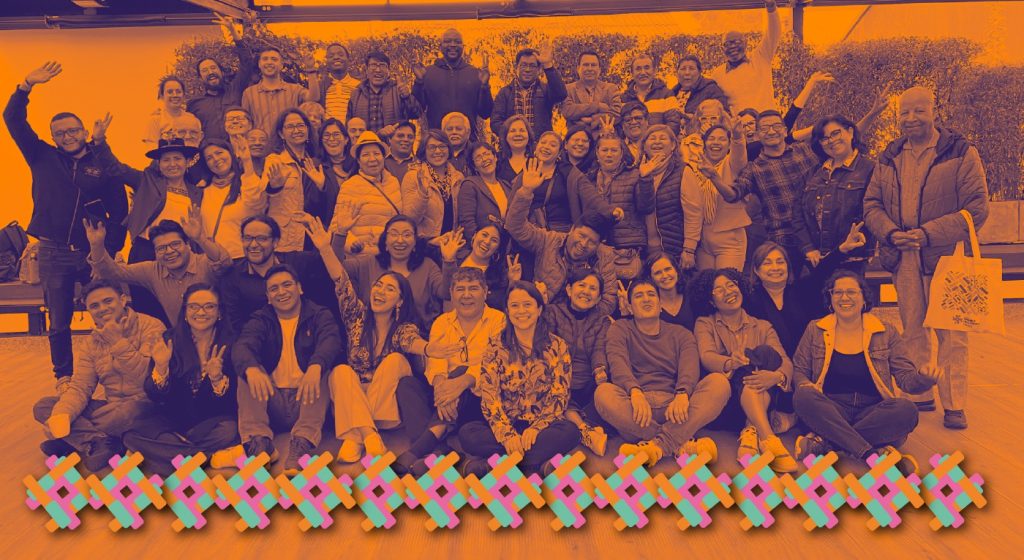
To confront this scenario, we organized the “Imagining with Others” meeting, which took place last month in Bogotá. It was an invitation to make a collective leap from that boiling pot: 20 Peruvian organizations — which were part of our Enlaza Strengthening Program — and experts from countries like Colombia, Nicaragua, El Salvador, Venezuela, Russia, Hungary, and the United States came together to exchange diagnoses, outline strategic routes, and strengthen alliances capable of confronting the “authoritarian contagion” and financial suffocation.
Sources of Heat That Demand Immediate Action
- Normative contagion: Anti-NGO laws replicated from country to country (such as the Peruvian APCI) that restrict funding and monitor activities under false arguments of “transparency.”
- Evaporated funding: Traditional donors (e.g., USAID) prioritize national security, leaving a void in funding for advancing human rights.
- Territorial disconnection: Organizations lose ties with communities, weakening their legitimacy in the face of stigmatizing discourse.
- Narrative traps: Stigmatization and divisive labels like “caviarism” in Peru, which fractures the social movement by presenting social organizations as “opportunistic elites” disconnected from communities.
Five Strategies to Jump Out of the Water
- Overcome fragmentation and articulate regional networks: Build dialogue spaces between civil society organizations, academia, and communities to define common agendas and raise our voice in multilateral forums.
- Diversify funding and explore social business models: Invest in individual donations, volunteering, community work, consulting service sales, and public-private alliances to ensure financial autonomy.
- Reinvent communication and expand narratives: Strengthen community media, use digital tools — including AI applied with ethical rigor — and humanize stories to connect with diverse audiences.
- Resist restrictive legislation: Promote strategic litigation, monitor the impact of norms like the APCI Law in Peru, and denounce anti-NGO regulations.
- Consolidate internal and international solidarity: Learn from networks like Red Muqui and INCLO, sharing resources, experiences, and unified messages to confront the “polycrisis” — climate, social, and economic.
The “Imagining with Others” meeting went beyond diagnosing the crisis to establish commitments. It showed that the survival of civil society in the face of authoritarianism depends on its strategic adaptation and the articulation of solidarity networks.
Some of our speakers included:
- Ginna Romero – UN Special Rapporteur on the Right to Peaceful Assembly and Association.
- Javier Ciurlizza – Director of the Ford Foundation in the Andean Region.
- Ligia Bolívar – Director of Alerta Venezuela
- Juanita León – Director of La Silla Vacía
- Maureen Meyer – Vice President of Programs at WOLA
- Carlos González – Executive Director of Makaia
- Stefánia Kapronczay – Obama Fellow at Columbia University.
- Pavel Chikov – Director of Agora.
- Laura Kauer – Director of the Civic Space Program at INCLO.
- Ricardo Esquivia – Founding leader of the Regional Peacebuilding Space of Montes de María.
- Katya Salazar – Executive Director of the Due Process Foundation-DPLF.
- Pedro José Carballo Monterrosa – Director of the Rural Communication Team Corporation Montes María
- Camilo Sánchez – Director of the Human Rights Clinic at the University of Virginia.
- Tania Pariona – Executive Secretary of La Coordinadora.
- Jaime Borda – Executive Secretary of the Red Muqui.
- Jennifer Erazo – Regional Advisor for Civic Space at Oxfam.
- Miguel Lévano – Program and Alliances Coordinator at Oxfam.
- Carolina Dueñas – Independent Consultant specializing in strategic communications, gender, and human rights.
Want to help boost the Enlaza Strengthening Program?
If you would like to learn more about our Enlaza Strengthening Program, participate, or support its expansion to reach more organizations, you can write to the coordinator Nina Chaparro (nchaparro@dejusticia.org). Your collaboration is key to strengthening the human rights movement in the Global South.
