


Posts Tagged ‘peace’
Peace that kills
This week gave us a crude sample of the violence that inhabits us. The FARC, number one social enemy, did not kill, did not kidnap and did not take hostage any town in recent days. They were doing a mannequin challenge.
Read MoreEviction of the peace camp broke regional, national, and international laws
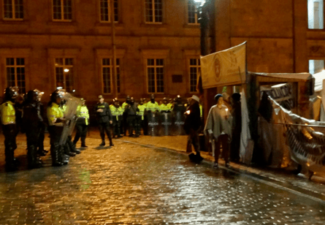
Our lawyer Anna Joseph
wrote a blog for the Huffington Post on the eviction of the peace camp in
Bogota, explaining the numerous national and international laws that were not
respected during the dismantlement. The blog was published in Spanish by Las 2
Orillas.
We need more, not less democracy
Many have criticized the government’s decision to call a plebiscite on October 2nd. Popular ratification was not judicially necessary. Even some, like Montealegre or Ferrajoli, claim that it was judicially questionable. For these reasons, several, including the president, have suggested that eventually, a new accord should not be subject to a popular referendum.
Read MoreGender and peace
The support of many Christians to the peace process will depend on them abandoning their opposition to the accord based on what they have called “gender ideology.”
Read MorePeace and the prisoner’s dilemma
After a month of observing and participating in joint meeings between the speakers of the NO and YES, Ihave two conclusions and two mixed feelings.
Read MoreMarching for a wide bloc for peace
The massive march last Wednesday confirms that a wide bloc for peace is consolidating: students, indigenous people, farmers and citizens of all ages that converge on an expedited and reached by concesus peace, whether they voted on October 2nd or they voted in favor or against the accords.
Read MoreThe Special Peace Jurisdiction: between jail and restorative justice
One of the innovations of the Special Jurisdiction Peace within the Peace Accord is the way in which it combines retributive and restorative justice, which is better, at least in its design, than many other transitional arrangements.
Read MoreAn impunity accord?
vote NO on the plebiscite claim that they are not against negotiated peace, but
that they believe the accord to be unacceptable because of the impunity it establishes due to the fact that it does not require jail time
for all those responsible for international crimes like massacres, kidnappings,
disappearances, children recruitment or sexual violence.
A new path for the International Criminal Court and peace processes?
One of the issues that has generated most debate in international legal circles is whether the justice and accountability component of the Colombian peace accord contradicts the State’s duties in terms of international criminal law.
The book of peace
It is not the most brief volume.
Read MoreDaydreaming
At this point, with a few hours left until it is time for the traditional grapes and apple cider, the risk-takers have made all the political predictions for next year. Some have already re-elected Santos, other have reached a peace agreement, elected a new Congress and formed parliamentary coalitions.
Read MoreCoalition Report UN Resolution 1325 on Peace and Democracy in Colombia
Since 2011, Coalition 1325 has drafted a report on UN Security Council´s Resolution 1325 monitoring the implementation of the Resolution in Colombia. This year, given the peace dialogues between the Colombian Government and the FARC-EP, this report is especially important because Resolution 1325 calls upon signatory states to include women in peace processes and post conflict scenarios, and to guarantee the rights of the women victims of armed conflict.
Read MoreRe-election, Peace and Democracy
A closer look at the dates when high-level government officials will be chosen reveals the enormous concentration of power that the re-election of President Santos could bring. The balance of power must be re-established and there are concrete ways of accomplishing this.
Read MoreInjustices and Wars
Injustices cause wars but wars, in turn, also cause injustices. In Colombia, for example, injustice derives from the high inequality in agrarian land ownership, which was used by the guerrillas as a justification for their armed uprising.
Read MoreThinking of the Issue of Drugs Alongside the Peace Process
Now that the different peaces and post-conflict scenarios in Colombia are being discussed, it is crucial to include the problem of illicit drug prosecutions in the debate. From what perspectives should we approach this problem so that we don’t make the same mistakes of the past?
Read More