


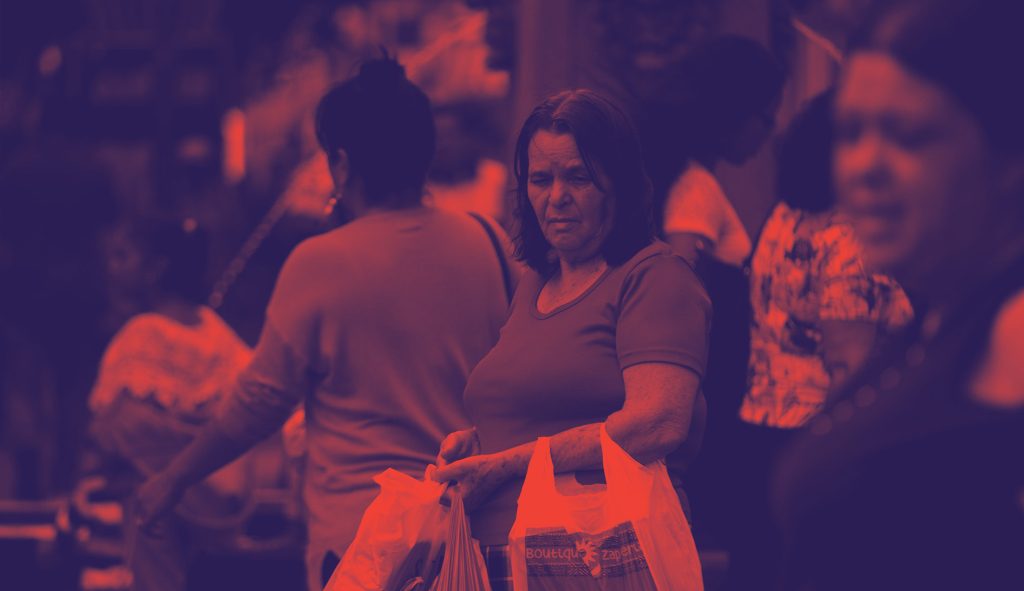
“Behind every tax there is a political decision.” | EFE
What’s in the shopping cart: the hidden history of “neutral” taxes
Por: Diana Esther Guzmán Rodríguez, Mariana Matamoros | October 10, 2025
Every Saturday morning, Tatiana repeats the same ritual: she takes her notebook, checks what’s left in the cupboard, and calculates how much she can spend at the supermarket. She lives with her two children and her elderly mother. She works part-time in a clothing factory, where she earns barely minimum wage. The rest of the day is devoted to caregiving: cooking, cleaning, looking after her mother, and helping the children with their homework. Like millions of women around the world, Tatiana performs care work that is essential to making everything function, but she receives no pay, recognition, or rest. This work sustains households, communities, and even the economy. However, its existence and value are rarely acknowledged.
That Saturday at the supermarket, Tatiana walks the aisles as if she were walking a tightrope. She needs soap to wash clothes, floor cleaner, trash bags, and bathroom disinfectant. She also needs cereal and some candy that the children love, fruit, and some vegetables. But she doesn’t have enough money for everything. She ends up leaving the cleaner on the shelf. “Another day,” she says to herself.
What Tatiana doesn’t know, and what many people don’t see, is that part of what makes these products so expensive is value-added taxes (taxes created for consuming goods and services). These taxes appear to be the same for everyone. In theory, they are neutral. But in practice, they impose different burdens on different people.
The neutrality of the tax system and care work
When we talk about taxes, we rarely think about people like Tatiana. Tax systems are supposed to be efficient, neutral, and balanced. And yet, every decision about which products are taxed, how much, and why has a direct impact on the lives of people like Tatiana.
So-called “tax neutrality” has long been an ideal in fiscal policy. In simple terms, it means that taxes should not alter the economic decisions of individuals or businesses. They should not favor or punish any particular activity. They should simply collect revenue without intervening.
But what happens when that ideal of neutrality ignores inequalities? What happens when it treats those who are profoundly different in terms of conditions and burdens equally?
Consumption taxes (which apply to products such as cleaning supplies, hygiene products, and processed foods) hit low-income households hardest, where every penny counts. And if those households are supported by women caregivers like Tatiana, the effect is amplified. Because they don’t just consume, they sustain.
There is no neutrality when the tax system is based on those who make life possible for others, without support or compensation. The work that makes everything function (housekeeping, cooking, cleaning, etc.), although not always visible or valued, is also the least supported. Thus, what appears to be a “neutral” rule actually perpetuates injustices that affect those who contribute most to the common good. For a woman who is the sole caregiver for her family, struggles to buy the basics, and has no stable income, the tax burden of paying VAT on the products she buys for her family is greater than for someone with a high salary who can afford help at home and choose what to buy without worrying about the price.
Faced with this scenario, many tax policies have begun to incorporate aspects that break with this false neutrality. For example, taxes on tobacco or alcohol seek to discourage their consumption for public health reasons. Or tax incentives for electric vehicles seek to promote environmental sustainability. In these cases, the state uses taxes not only to finance itself, but also to guide certain behaviors. Therefore, breaking neutrality is not a mistake, but a tool to achieve goals that benefit society as a whole.
Why not design tax systems that recognize the social value of care?
Tatiana does not need a lesson in economic theory. But she does need (like so many others) for her daily efforts to stop being invisible. She needs the cost of cleaning a house not to fall solely on her shoulders. She needs the system to stop treating decisions that, in her case, are about survival as “neutral.”
Tatiana’s story is a common one. And for that very reason, it should be the starting point for any rights-based reflection on taxation. Because behind every tax there is a political decision. And behind every decision, there is a life that is affected.
There are concrete proposals aimed at recognizing the importance of considering gender inequalities and care work in public policies at the national and international levels. For example, in terms of taxation, Tatiana could benefit from tax exemptions on personal care and household products, access tax refund measures such as VAT on spending on basic goods, and the company where Tatiana works could receive tax breaks for flexible working policies.
Meanwhile, the State can strengthen time use surveys, implement gender markers in tax returns to analyze who has the greatest tax burden, promote equal parental leave, recognize weeks of contributions for caregivers’ pensions, and invest in daycare, care for the elderly and people with disabilities, or in the care blocks implemented in Bogotá, D.C. recognize weeks of contributions toward pensions for caregivers, and invest in daycare, care for older adults and people with disabilities, or in the care blocks that have been implemented in Bogotá, D.C. since 2020, so that women like Tatiana can access free self-care, education, training, and care and recreation services for dependent persons.
Reviewing the principle of tax neutrality is not a technical debate, but an ethical discussion: Does it benefit Tatiana? Does it harm her? How can a system be designed that not only works, but also helps Tatiana in caring for her home and does not make her feel excluded from fiscal policies? Today, in a world where inequality is growing and women like Tatiana have low incomes and heavy responsibilities, we cannot afford to continue talking about neutrality because it does not exist.
True fiscal efficiency lies in correcting inequalities from the very design of the system. And that starts by looking at Tatiana’s shopping cart with fresh eyes and asking ourselves how fair it is to impose a tax that makes life more expensive for those who already give everything to sustain it.

