The Montes de María Rural Communication Team has been telling stories about rural life for 10 years. Photo: Marcela Madrid. |
Montes de María, a treasure trove of stories
Por: Marcela Madrid | July 19, 2023
They are there, with cameras on their shoulders and microphones in hand, to tell the world every time their communities march demanding health, education, or roads. With the same energy, they appear when rice is hulled, ‘mote de queso’ (a traditional cheese soup) is prepared, and women braid their hair. All are scenes of the peasant, indigenous, and Afro resistance that the Montes de María Rural Communication Team has dedicated itself to telling since they got tired of being told by others.
It was about ten years ago. The peasant and ethnic organizations in this area, grouped on a platform called OPDS, realized that they needed to position their rural development agenda among the communities and show the country their efforts to achieve “a dignified permanence in the territory,” as their motto says. Thus, they were convinced, these struggles would have more collective strength and more echo to attract the attention of the State. Although some of their complaints were heard by the media, the feeling that remained was almost always one of disappointment: the coverage ended up misrepresenting their claims.
The only alternative was to tell their own stories. A dozen rural leaders of all ages signed up for the challenge. They would continue to defend causes such as the protection of seeds, victim reparations, or access to water, but they would also dedicate themselves to telling the stories of these struggles. They discovered they were communicators along the way, through trial and error. They combined their political training with the communication workshops offered by the Corporación Desarrollo Solidario, an NGO that has been accompanying rural processes in this region since the 90s.
Their first campaign was a series of short documentaries called Cultivating food is harvesting peace. In it, they tell the stories of several peasant, indigenous, and Afro communities that continue to produce food on their plots despite being suffocated by agro-industrial projects (of palm, pineapple, and teak) that monopolize land and water.
Since then, they have produced documentaries and podcasts about the environment, women, peasant economies, and childhood that have competed in national festivals and are often disseminated in universities. In 2019, they recorded the music video Pa’ sembrar with the group Systema Solar, an anthem to Creole seeds that featured a community from the high mountains of El Carmen de Bolívar.

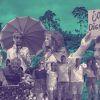
The Communication Team covering a peaceful walk of the rural communities to Cartagena. Photo courtesy of the Rural Communication Team.
Six minutes of impact
With a six-minute documentary, they achieved the unthinkable: a representative of the State came to their communities. It was March 2017, the drought was raging, and the rural leaders of El Carmen de Bolívar, San Jacinto, and Marialabaja were preparing to undertake a peaceful walk to Cartagena. The plan was to get to the office of the Governor of Bolívar and demand answers for the promises about education, health, and roads that the mayors of these municipalities had failed to keep.
The Communication Team recorded all that preparation and also organized a kind of mock march. The video shows the peasants leaving their villages on donkeys and explaining the reasons for the walk. One peasant woman denounces that the road is very deteriorated and the products are being lost; another man explains the journey they have to make when a snake bites them or they cut themselves with a machete. “We’re going to Cartagena, let no one be left behind!” is heard in the background.
Many of the new commitments were forgotten again, but that was the beginning of a long struggle that included several walks and that today has some corregimientos in the area with electricity, nine kilometers of paved road, and classrooms built.
At every step of that journey, the Rural Communication Team was present, with banners and cameras; with microphones and chants. Although some believe they are just “the ones with the cameras” or confuse them with a production company, the 16 members of the Team are clear that their work is part of the same cause: “the defense of rural territories as an intercultural, food-producing, and biodiverse land.” For this reason, their content is not a product of the latest trend on social media, but rather responds to the agenda of the organizations that trust them to make them visible.
Where are the stories?
In front of a handful of young Afro people, Yefri Paola Cervantes shows the enormous narrative possibility that exists in her territory: “Who among you has used ‘manteca negrita’ (little black butter) on their hair? My mother used to style my hair with that. From these small things, great stories can be born, the important thing is to know how to tell those stories.” One of the examples she uses to demonstrate this is a short film about ‘manteca negrita’, that oil that Afro women extract from the corozo palm and use to style hair. The video -which brought smiles and the occasional “woooow” from the audience- was produced by children from the Team as part of the series Flavors and knowledge of my land.
They are in a kind of open-air room in the corregimiento of Márquez, Marialabaja, a few meters from the road to Cartagena. Yefri, a 34-year-old communicator raised in a nearby fishing community, arrived there, along with Daniel Arroyo, a 25-year-old popular journalist from El Carmen de Bolívar. Both are part of the Communication Team and were invited to give a workshop on producing stories with a cell phone. Their audience is the sons and daughters of community leaders, adolescents who are just beginning to get involved in social processes.
Before explaining the types of shots and framing, Yefri and Daniel invite them to think about stories from their communities that are worth telling. The result of this brainstorming includes a complaint about an overflowing stream, the promotion of dams as tourist places, and educational content about the ancestral meaning of braids. Then Daniel explains the technical minimums for a good audiovisual production, for example, that “a very close-up shot is useful when you want to show that they are cutting a yucca.”

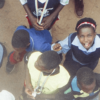
Yefri Cervantes and Daniel Arroyo lead a workshop with young people from Marialabaja. Photo Marcela Madrid.
The workshop progresses with the heaviness that the afternoon heat brings. In the background, three women tell stories under a mango tree, while Yefri invites the young people to join the Team’s communication nursery. To motivate them, she excitedly tells them that one of the children in the videos is named Pedro Carballo, he is now 23 years old and is the legal representative of the Team. Thanks to his work, which began with productions like that of ‘manteca negrita’, he is studying for a degree in Audiovisual Communication with a full scholarship in Barranquilla, “in a very Caribbean university.” She also points to Daniel, by her side, to tell them that he is studying Audiovisual Communication in Cartagena and that his scholarship was the product of the 80 or so agreements that the Governor of Bolívar signed after one of the peaceful walks to his facilities.
These opportunities could lead Pedro and Daniel to major media outlets or production companies, but their life project is in the Montes de María. Yefri, who also studied Communication in Cartagena, emphasizes that message to the potential communicators of Marialabaja: “we all have personal projects, like starting a family or being professionals, but we never forget where we come from.”
Living from the craft
The decision of Yefri, Daniel, and Pedro to give back to the Montes de María what it has given them has not been easy. Although the Team has managed to have their work recognized economically (thanks to alliances with local and national organizations), they are still working to be sustainable. Despite the passion for the craft and the love for these fertile lands, some of their colleagues have had to go to the cities in search of a salary “in whatever comes up.” To avoid that fate, the commitment of the Rural Communication Team – which recently became a Corporation with the advice of Dejusticia – is to apply for calls and continue creating networks with other social processes to ensure that their talent allows them to live a dignified life in the territory.
In any case, Yefri will continue to record – together with the Caribbean Women’s Coalition – a podcast about rural women and new masculinities, in which she questions peasants with questions like “do you feel comfortable if a woman works next to you swinging a machete?”. For his part, Daniel will continue to produce stories about the David and Goliath-like dispute between the peasantry and the palm businessmen over the use of the dams. Meanwhile, ‘Pedrito’ plans his dream job: a series about a boy who loses the water in his community and travels through the Colombian Caribbean to learn how other communities have managed to conserve their water sources.
They are personal dreams that are found in a common ambition: to position the Montes de María as a pantry of stories.
(*) Journalist at Dejusticia
(**) This article is part of the special #TejidoVivo, a product of a journalistic alliance between the Dejusticia study center and El Espectador.