| EFE
When spending and freedoms are restricted. Milei’s Argentina
Por: Sofia Forero Alba, Victoria Fernández Almeida | September 1, 2025
Since Javier Milei became president in December 2023, Argentina has been experiencing a paradox: while promoting drastic economic adjustment, it is simultaneously cutting back on the civil liberties necessary to resist it. This is not an isolated or atypical phenomenon. In authoritarian governments or those with authoritarian tendencies, it is common for measures aimed at extreme economic adjustment, as well as the advancement of extractive projects, to go hand in hand with the restriction of civic space and the criminalization of protest. This criminalization, control of public space, and harassment of those who defend collective rights have become tools for sustaining regressive and extractivist economic models that impoverish and increase inequality.
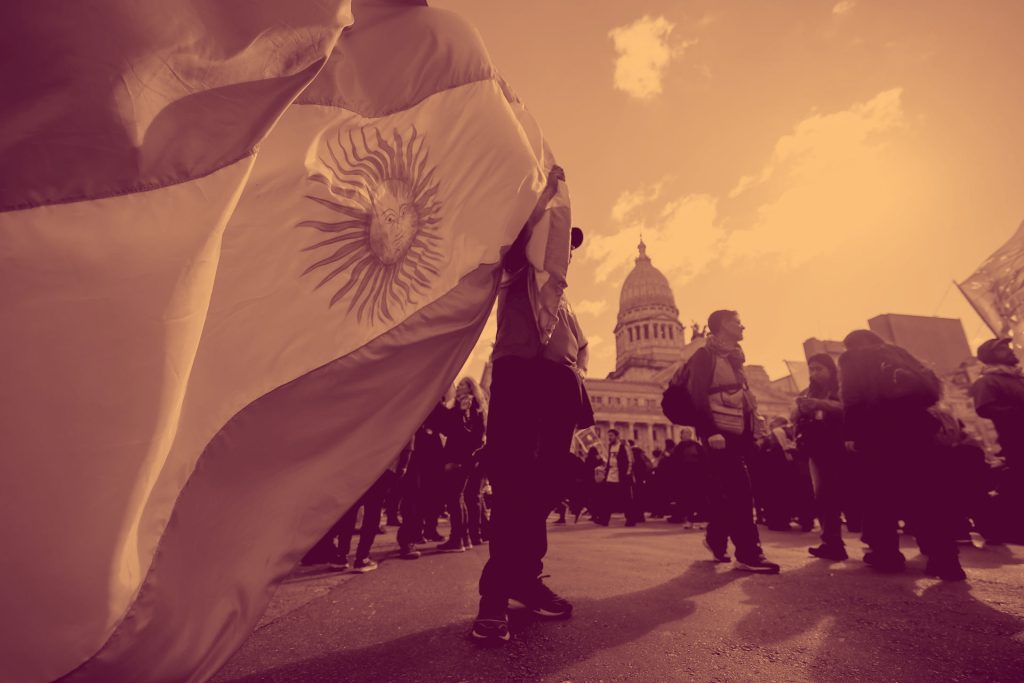
Argentina, with a strong tradition of social mobilization, has historically responded to economic adjustment policies with intense protests. Each new economic crisis or attempt at adjustment rekindles the collective memory and forms of protest, consolidating a tradition of mobilization that responds not only to material conditions but also to a political culture of resistance to policies perceived as exclusionary and regressive. Faced with the mobilizations that have increased since Milei took office, the Argentine government has chosen to delegitimize the demands, minimize their scope, and repress them.
Since December 2023, Javier Milei’s government has implemented policies that combine severe fiscal austerity—for example, closing ministries, laying off public employees, cutting funds to the provinces, slowed down public works, lowered subsidies for public services, and cut social assistance, vetoed initiatives from both houses of Congress aimed at updating retirement, disability, and university benefits—with forms of state repression, creating a worrying scenario for human rights and democracy in the region. At the same time, this represents a setback in guarantees for exercising the right to protest.
Although Milei has made the slogan “Long live freedom, damn it!” famous, it is civil liberties that are going “to hell” under his government. The imposition of deep economic austerity has been accompanied by serious restrictions on civic space and civil society participation in political, economic, and social life. Along with the advancement of these economic measures, he has limited the exercise of freedom of expression and assembly, reducing the channels of protest that people usually resort to when there are measures with which they disagree. Three examples illustrate these trends: the so-called Bullrich protocol to criminalize protest; the providential reforms in areas of high socio-environmental conflict; and the shielding of business interests of extractive industries and adjustment policies from any form of community resistance.
The Argentine experience shows how, even in democracies with a long tradition of social mobilization, authoritarian practices can become entrenched. This case extends beyond borders to governments that, in the name of fiscal stability or attracting investment, erode basic freedoms and seek to reconfigure the relationship between the state, the market, and civil society.
The Bullrich Protocol: criminalization of protest and social repression
The sequence between drastic economic measures and social repression is clear. Devaluation, fiscal adjustment, and the prioritization of foreign currency inflows have coincided with the implementation of a security protocol that criminalizes protest and a security policy that decided to create a special force for the defense of productive activities. While the protocol is part of a broader strategy to delegitimize and criminalize social mobilization, the formation of the special unit directly reveals the close relationship between adjustment policies and repressive measures that seek to favor specific economic interests.
As a first precedent, on December 14, 2023, the Ministry of Security, led by Patricia Bullrich, published a protocol limiting the right to protest, authorizing the use of force in the event of roadblocks and requiring prior notice for demonstrations. This measure, justified as a guarantee of “public order,” was applied days later during the December 20 picket march, setting a precedent for the criminalization of social mobilization.
The protocol stipulates that any public demonstration that involves blocking streets or roads and affects vehicular traffic or reduces the available width of roads, streets, or avenues will be considered a crime In flagrante delicto. This enables the security forces to intervene to evict or disperse the protest, as well as to identify the individuals and organizations involved with the aim of initiating criminal proceedings against them. Not only does it nullify the right to protest, but it also enables a disproportionate response against vulnerable sectors, such as retirees, as evidenced by the repression on March 12, 2025, in Buenos Aires, which was the most ferocious to date; however, this type of intervention is repeated systematically every Wednesday.
Security forces violently advanced on protesters, using batons, rubber bullets, and tear gas, in a scene that starkly exposed the government’s insensitivity and the criminalization of social protest. The image of retirees being beaten in the streets was recorded as a symbol of the deterioration of democracy and contempt for the sectors most affected by economic measures.
Provincial reforms and repressive crackdown: the case of Jujuy
In northwestern Argentina, where the lithium boom generated community resistance, regulatory and repressive frameworks were applied early on and later extended nationwide, with Jujuy serving as a key laboratory for these policies. In 2016, a Misdemeanor Code came into force that criminalizes social protest and has been systematically used to prosecute social leaders. In 2023, the constitutional reform—with the incorporation of Article 67—not only deepened this framework, but also significantly increased fines for misdemeanors, reinforcing a legal framework that discourages social mobilization. In this scenario, repressive national policies are aligned with provincial ones, which is particularly burdensome in Jujuy. This is because, unlike other jurisdictions, the criminalization of protest was already well established before the current national government, creating a sense of continuity and aggravation of the curtailment of rights.
This provincial process is part of a national scenario marked by a package of regressive economic measures aimed at generating “confidence” in the market at the expense of social rights. Among these measures, the most notable are the abrupt devaluation of the peso—which doubled the official dollar value from $380 to $800—and the increase in the PAIStax to 17.5% for non-agricultural imports and exports. At the same time, a drastic reduction in public spending was implemented: non-renewal of recent state contracts, elimination of the official advertising budget, cuts in transfers to provinces, and a halt to new public works. Added to this were announcements of cuts in energy and transportation subsidies, which translated into significant increases in the cost of living for large sectors of the population.
This repressive and economic framework puts double pressure on the territories, limiting access to rights and reinforcing extractive advances in the face of community resistance. In this context, the so-called green transition does not escape these dynamics. Although it is presented as a response to the climate crisis, in reality it translates into a new phase of extractivism, with regulatory and repressive shielding that ensures the continuity of the model.
Extractivism and protection of productive enclaves
In addition to the processes already mentioned, the Large Investment Incentive Regime (RIGI) was recently approved, granting tax, customs, and exchange benefits for 30 years to projects exceeding US$200 million. In Argentina, as in other countries in the region, these large investments are mainly directed towards extractive activities such as mining, fracking, and agribusiness.
These activities take place in regions inhabited mainly by indigenous and peasant communities. Paradigmatic cases include Vaca Muerta—the country’s largest hydrocarbon venture—and Salinas Grandes and Laguna de Guayatayoc—a basin shared between Jujuy and Salta where 33 indigenous communities have been resisting the entry of lithium projects for more than a decade. In Vaca Muerta, the Mapuche community of Campo Maripe has been prosecuted for exercising its right to self-determination and reclaiming its ancestral territory. In Jujuy, the communities of Salinas Grandes have faced threats, harassment, and criminal charges in the context of their opposition to the constitutional reform in 2023. These actions are not isolated incidents, but part of a pattern of criminalization of defenders of the territory, carried out by both the state and private actors.
The recent approval of one of the first lithium projects under the RIGI umbrella, and the existence of at least seven others under evaluation, foreshadow a scenario of increased extractive pressure on these territories.
In parallel, the national government created the Unified Command for Productive Security in September 2024 through Ministerial Resolution No. 893/2024. This mechanism coordinates security forces on the grounds that certain economic sectors require “special security” due to their relevance to the country’s growth. This enables intervention in the event of protests that impede or block traffic in key areas such as ports, mining enclaves, or hydrocarbon fields.
The combination of the RIGI and the Unified Command creates a regulatory and institutional framework that reinforces the advancement of extractive interests through exceptional mechanisms. In this context, defenders face a legal and repressive siege that threatens not only their freedom but also their lives. Thus, the state ceases to act as a guarantor of rights and becomes a manager of conditions that prioritize capital profitability over human rights.
What’s at stake? Rights, democracy, and resistance
Faced with the prospect of profound economic adjustments and the closure of civic space, it is necessary to warn about the differential impacts of these measures, especially on communities defending their territories. In countries of the Global North, such as the United States, there is also a worrying process of dismantling social rights, weakening the rule of law, attacking the organized social fabric, and advancing political projects that seek to limit fundamental freedoms. In this context, Latin America is part of a broader wave in which economic adjustment and authoritarianism feed off each other. The delegitimization of protest, control of information, and repression not only seek to discourage organizing, but also restrict channels of citizen participation, weakening democracy and leaving people with fewer tools to assert their rights.
Argentina is a country that stands out in the region for its strong social mobilization and the sustained use of social protest as a democratic mechanism that has enabled the aquisition of rights and the prosecution of major human rights violations. It is therefore urgent to strengthen networks for documentation, reporting, and solidarity, both locally and internationally, to prevent repression from becoming normalized as a tool of government. The defense of civic space, of the right to organize, demonstrate, and defend the common good, is today one of the few brakes on the advance of economic and political models that strip away rights and consolidate new forms of exclusion.