


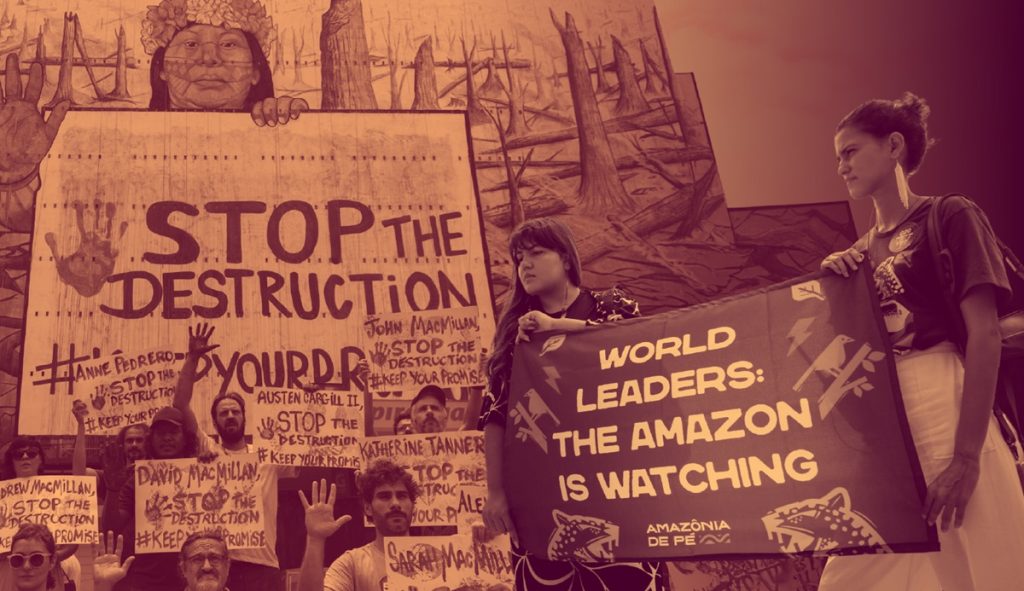
The threat is intensifying: by 2030 it is estimated that the Amazon could lose up to 27% of its forest cover, i.e. 854 million hectares. | EFE
A guardian of the Amazon: Taxation for sustainability
Por: Mariana Matamoros, Diego Sardón Tupayachi | July 2, 2025
The Amazon, which extends across nine countries and sustains the lives of more than 47 million people, is a fundamental pillar for global climate regulation and ecological balance. Each hectare lost represents not only the disappearance of irreplaceable natural resources, but also aggravates inequalities and affects ancestral ways of life. This reveals the urgency of rethinking our fiscal policies, especially the taxes paid by multinationals engaged in the exploitation of natural resources.
This is why nations must transform their tax models, which have allowed the degradation of the world’s lung, into a force for action and protection. Currently, new fiscal paradigms have been proposed, based on international cooperation, capable of holding accountable those who extract without limits and, at the same time, generating the resources indispensable for conserving and restoring the Amazon. With an approach that integrates environmental justice and equity, we explore some key measures to defend this natural treasure, to ensure a legacy of dignified and sustainable life for future generations.
The soul of the forest in danger: Transforming pain into action
Over the last few decades, the Amazon has undergone a painful and accelerated transformation. The unbridled expansion of intensive agriculture in countries such as Brazil, Peru and Colombia has triggered a massive loss of forests, as if every year the forest were losing a vital piece of its soul. Between 2001 and 2020, the region was reduced by more than 54.2 million hectares – equivalent to 8.7% of its area, almost the size of France – and the threat is intensifying: by 2030 it is estimated that the Amazon could lose up to 27% of its forest cover, i.e. 854 million hectares.
This devastation is exacerbated by the voracious export of products such as meat and soy to markets in China and Europe, which accelerates the exploitation of these essential ecosystems. So far, approximately 17% of the Amazon has been deforested, and current rates suggest that we will soon reach a critical limit.
Behind these numbers lies a deeply human story. More than 47 million people, including 2,2 million indigenous people, depend directly on the forest for their survival. These communities face multiple vulnerabilities: social, as they are excluded and have unequal access to basic rights; economic, as they depend on activities that are being devastated by the degradation of the territory; and environmental, due to the direct impact of climate change and the loss of essential ecosystem services.
Redefining the value of the Amazon: Taxation for conservation
The Amazon is much more than an immense forest: it is a natural treasure vital for humanity. Its soils, forests and biodiversity provide us with essential services – climate regulation, water purification, pollination and food production – on which more than 50% of global GDP depends. Its ability to capture carbon and its incomparable biological wealth make it an indispensable pillar, whose water cycles sustain life in the forest and benefit agriculture, industry and both local and international supply chains.
However, this wealth is threatened by a paradoxical fiscal scenario: while countries struggle to gather the necessary resources to protect their ecosystems, large multinationals operate with negligible taxes, taking advantage of regressive tax systems and tax havens that form part of the current international financial and tax architecture. For example, it is estimated that 68% of foreign capital invested in soy and meat companies in the Brazilian Amazon is channeled through these havens, severely limiting the ability of governments to finance sustainable projects that address both climate change and deforestation.
Inaction in the face of climate change has a very high cost, with extreme phenomena damaging infrastructure and requiring large resources for repairs. Today, the region’s economies allocate less than 1% of their GDP to mitigate these impacts: while Colombia invests barely 0.3% and Peru only 0.1%, it is estimated that a minimum of 1.5% is required to address the situation.
In this scenario, it is vital to implement fiscal policies that penalize those who exploit without assuming the environmental costs and, at the same time, mobilize the indispensable resources at the local level and through international cooperation for the long-term conservation of the Amazon. This fiscal reconfiguration is essential to unite environmental protection and sustainable development.
Towards protective taxation: Integration between human rights and sustainability
It is important to detail how fiscal instruments can be aligned with international commitments on human rights and sustainability, to discourage deforestation, promote conservation and provide the necessary financial resources to Amazonian countries to achieve the sustainability of the ecosystem.
The implementation of the Human Rights Principles in Fiscal Policy – a collaborative initiative of civil society – emphasizes that economic decisions must guarantee equitable access to resources and opportunities. This requires establishing transparency rules that oblige corporations to respect and promote economic, social, cultural and environmental rights. Likewise, it is key to promote international cooperation to combat tax evasion to ensure that Amazonian countries have the necessary resources to face the crisis.
In this sense, we propose comprehensive fiscal measures that fulfill two objectives: to penalize overexploitation and to generate incentives for conservation. These include:
- Increasing environmental taxes, such as those on water and plastic use, taxes on polluting vehicles, and on the extraction of natural resources to provide the authorities with resources to repair the damage caused by overexploitation.
- Raising the carbon tax and eliminating tax exemptions that benefit large emitters. This would incentivize emission reductions and finance mitigation projects.
- Establish higher taxes on land use change in forest areas or areas of high ecological value to discourage the conversion of these spaces into agricultural or urban land.
- Apply progressive taxes on the wealth of large corporations and billionaires linked to the exploitation of the Amazon, and allocate these funds to conservation, ecological restoration and climate change mitigation programs.
In the field of public spending, it is essential to design redistributive policies that benefit the most vulnerable populations, to reform or eliminate subsidies that encourage the overexploitation of the Amazon and to redirect those resources towards sustainable activities. Furthermore, eliminating tax benefits for large extractive corporations — which in reality represent an expense for the state — and establishing a rigorous system of traceability in the supply chains associated with deforestation are indispensable steps to guarantee compliance with environmental and social standards.
These fiscal measures seek, in addition to tackling deforestation, to create sources of resources to incentivize the conservation of the Amazon. With this approach, a bridge is built between environmental justice and social welfare and a path is laid out towards a sustainable future for this invaluable ecosystem.
Commitment and hope: A fiscal path for a living Amazon
Saving the Amazon requires transforming the pain of deforestation into an urgent and collective commitment. It is imperative to design a comprehensive approach that combines sound public policies with a fair tax system. By taxing the large corporations responsible for degradation in an equitable manner, essential resources will be freed up to conserve and restore this natural treasure. Simultaneously, redirecting subsidies that currently promote activities that deplete the Amazon towards sustainable initiatives is the key to development that respects both communities and biodiversity.
This reconfiguration is not just an accounting adjustment, but the promise of a future where every tree protected and every habitat restored translates into a dignified life for generations to come. It is the opportunity to turn fiscal inaction into a transformative force, of national and international cooperation, that defends the natural and cultural heritage of the Amazon, that ensures that the richness of this vital lung continues to be the treasure of a planet committed to environmental and social justice.


