


Issue-Judiciary
Justice in forgotten territories
Justice is a necessary condition to consolidate peace. We owe a coordinated, effective, and efficient state offer of justice to people in forgotten municipalities who have suffered the conflict.
Read MoreIndependence and judicial management: a democratic reading
The necessary independence of judges has been an argument against some attempts to reform justice. But it is a concept with multiple interpretations, and therefore we must clarify it in order to proceed with the reforms.
Read More¿Tutelitis o abusitis?
Las reformas a la justicia deben partir de análisis integrales. Esto no significa que no puedan incorporar herramientas específicas para enfrentar ciertos problemas como la congestión judicial. Significa que en ciertos asuntos, las reformas deben tener una visión de Estado.
Read MoreIt was to be expected
What is happening today in Colombia’s Judicial Branch was to be expected. It is a worrying trend in a country that requires more than ever a strong and reliable administration of justice for peace.
Read MoreLessons of the Special Jurisdiction for Peace
We do not have to look far to find immediate reasons against clientelism in justice. The judge selection for the Special Jurisdiction for Peace (JEP) has just given us two lessons that should be applied throughout the judicial system.
Read MoreThe door of the State
From the Supreme Court scandal, the first thing that surprises is the mediocrity of the magistrates involved, but the signs of a network of corruption are the most serious. If confirmed, this would be the worst institutional horror of the last decades.
Read MoreAgainst the bad: transparency
As we take deeper measures to deal with the serious judicial crisis that we are experiencing, the Courts and the General Attorney’s Office must adopt immediate transparency actions to face corruption and regain citizens’ trust.
Read MoreWhen missing people cannot be found, what happens with their property?
The property of missing persons is not only a home acquired, like for most Colombians, with much effort. For relatives of missing persons, this is the place where they have waited for the return of their loved one for years.
Read MoreIndolence against femicide

According to Forensic Medicine, of the 50,707 case of domestic partner violence registered in 2016, 86% were for violence against women, violence that in many cases ended in femicides.
Read MoreJudicial misinformation
We do not really know how many cases the justice system receives and solves every year. We also do not know how many civil, labor or family cases are registered, nor how many cases of certain behaviors like domestic violence are processed in the country. And no one seems to care about the absence of reliable information.
Read MoreIt is necessary to consolidate the JEP as soon as possible: press release

Dejusticia, together with other civil society organizations and academics, celebrate the definitive step of the FARC-EP’s abandonment of arms to end the conflict and stress the importance of consolidating the Special Jurisdiction for Peace as the next key step.
Read MoreGpaz and Dejusticia recommend the application of a gender based approach in criminal policy bill

The Working Group on Gender in Peace (GPAZ) and Dejusticia presented an analysis of Bill No. 148 of 2016 (currently in the Senate). The bill is currently being handled by the First Commission and amends provisions of the Criminal Code, the Code of Criminal Procedure , the Penitentiary and Prison Code, and the Childhood and Adolescence Code.
Read MoreAn organization with collective leadership: our history reviewed in the Leader Network

The Leader Network chose Dejusticia to initiate the series of profiles on collective leadership. The profile published in Silla Vacía investigates three fundamental measures of leadership: vision, example and results.
Read MoreCivil’s society second report on the penitentiary and prison situation

The Civil Society Commission Tracking the Sentence T-388 that Dejusticia makes part of presented a second report before the Constitutional Court.
Read MoreThe State Council’s decision did NOT change the rules for safe and timely abortion services

The high court, which for the first time recognizes the voluntary interruption of pregnancy as a fundamental right, also did not authorize the objection of institutional conscience for clinics or hospitals.
Read More“The Conception of the Constitutional Court is Too Narrow”

César Rodríguez Garavito spoke about the face-off between the government and Congress with the judiciary due to the Constitutional Court’s ruling about the judiciary in this interview with Cecilia Orozco for El Espectador.
Read MoreThe Ineffective Reform about the Efficient Use of Prison

Alerts the inconsistencies of the bill in Congress to reform Law 1760 of 2015 about the maximum duration of pretrial detention in Colombia.
Read MoreThe Trouble Caused by Seeking to Replace the Higher Council of the Judiciary

Was the remedy worse than the disease? Infographic.
Read MoreReport about the Administration of Criminal and Prison Policy
The Monitoring Commission, in which Dejusticia takes part, to the Colombian Constitutional Court’s T-388 Ruling presented its first report.
Read More20 Fundamental Rights for an Effective Criminal Defense
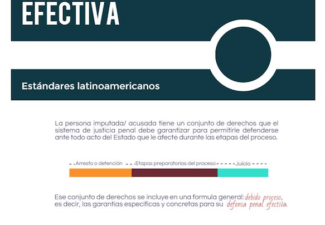
Infographic
Read MoreExperiences in Latin American Countries on the Investigation of Complex Crimes
In this document we describe some of the experiences in the region’s countries regarding the investigation of complex crimes.
Read MoreAccess to Justice: Cases of Business Human Rights Abuses
Access to justice and effective remedy have become a crucial element in the protection of human rights within the context of business activities, as well as an area of fundamental importance to judges and lawyers who aim to promote the rule of law and human rights.
Read MoreThe Penal Process Between Efficiency and Justice: The Technical Application of Judicial Direction of the Process of the Penal Accusatory System
This book examines the functions of direction, control and management in the process that should exert the Colombian judge into the framework of the new accusatory penal system that has been implemented by the Legislative Act 3 of 2002 and the Law 906 of 2004.
Read MoreThe Laws of the Judges
The Laws of Judges, already a classic of Colombian legal literature, offers in this second edition a substantial revision of its content and structure.
Read More