


Issue-Transitional Justice
The post-agreement or the next day
As many of us who voted
YES and others who voted NO, I was hopeful about a peace accord supported by
many. Not by all, because no war has ended in unanimity, but supported by
critics and defenders of the previous accord that had sought intermediate solutions
to complex dilemmas such as the sanctions for those responsible of serious
crimes.
Eviction of the peace camp broke regional, national, and international laws
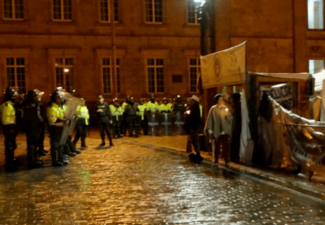
Our lawyer Anna Joseph
wrote a blog for the Huffington Post on the eviction of the peace camp in
Bogota, explaining the numerous national and international laws that were not
respected during the dismantlement. The blog was published in Spanish by Las 2
Orillas.
New agreement and disagreement
Accounting for the proportions, the equivalent to the construction of an avenue in a few days that later completely collapsed in Japan was for us the discussion and agreement of the peace accord in Havana.
Read MoreAn agreement about the agreement
The new accord collected the main objections of the NO campaign given that in only one important topic (political eligibility) there were no significant changes. But the new text also maintained the essence and structure of the previous accord.
Read MoreThe Best Possible Accord
Much has been debated about what is the best peace accord possible. Humberto de la Calle said the answer was the last one; now he argues that it is the new one. The most skeptical sectors of the NO said it is neither one or the other.
Read MoreWe need more, not less democracy
Many have criticized the government’s decision to call a plebiscite on October 2nd. Popular ratification was not judicially necessary. Even some, like Montealegre or Ferrajoli, claim that it was judicially questionable. For these reasons, several, including the president, have suggested that eventually, a new accord should not be subject to a popular referendum.
Read MoreGender and peace
The support of many Christians to the peace process will depend on them abandoning their opposition to the accord based on what they have called “gender ideology.”
Read MoreTrust for peace
A peace accord that does not count with a broad social and political backing will be hard to implement in the practice, even if it finds judicially appropriate ways.
Read MoreIn defense of the Constitution
If those who see themselves as spokespeople of the NO campaign developed
their argument against the Havana accord because it “modified the
Constitution”, they must honor their words and not make regressive
proposals on the Constitution they said to defend. But exactly the opposite is
happening with their arguments regarding what was agreed in terms of land
reform, under a supposed defense of private property.
Peace and the prisoner’s dilemma
After a month of observing and participating in joint meeings between the speakers of the NO and YES, Ihave two conclusions and two mixed feelings.
Read MoreShould They Put Up with It?
Should the neighbors of a police station, who suffer damage to their property or their person from guerrilla attacks directed against the police station, tough it out and assume the cost of these injuries on their own? Or, should the state compensate them so they can rebuild their lives?
Read MoreThe second round of the Legal Framework for Peace
Petro’s balcony –and now, Falcao’s knee—have managed to overshadow the recent Constitutional Court decision regarding the Legal Framework for Peace.
Read MoreThe Year of Hope for Peace
For those of us who were born in the 80’s, hope is almost an unknown feeling. We know that it is like an abstract idea, since we hear it from the mouth of leaders who fought against the violence. But back then the idea was not only never put in practice, it was also used to aggressively repress those who dared proclaim it.
Read MoreThe Struggle for the Law
The objective of law is to bring peace, but the way to get there is through struggle.
Read MoreCoalition Report UN Resolution 1325 on Peace and Democracy in Colombia
Since 2011, Coalition 1325 has drafted a report on UN Security Council´s Resolution 1325 monitoring the implementation of the Resolution in Colombia. This year, given the peace dialogues between the Colombian Government and the FARC-EP, this report is especially important because Resolution 1325 calls upon signatory states to include women in peace processes and post conflict scenarios, and to guarantee the rights of the women victims of armed conflict.
Read MoreIn Search of a United, Yet Institutionalized Left
Ivan Cepeda’s proposal of creating a broad alliance with a presidential candidate and a roster of congressional candidates is the Left´s best bet, not only for it’s future, but for the country.
Read MoreLand Reform in Colombia: One step Forward Two Steps Back
Land reform in Colombia, while politically sensitive, is necessary to stabilize the country and end a violent conflict that has plagued Colombians for more than half a century. Colombia’s internal fighting has deprived millions of their land and livelihood. Adopted in June 2011, Colombia’s Victims and Land Restitution Law, also known as Law 1448, is an important advance in providing restitution for those displaced by the conflict.
Read MoreThe Missing Persons of the Palace of Justice and the IACHR
It is contradictory for the Government to accept responsibility before the Inter-American Court of Human Rights (ICHR) for two of the disappearances at the Palace of Justice and for the torture of two of the detainees, but then try to minimize its responsibility with regard to the other nine missing persons or the execution of Clerk Urán, by saying that what happened was a merely a governmental failure, but not a disappearance or execution.
Read MoreInjustices and Wars
Injustices cause wars but wars, in turn, also cause injustices. In Colombia, for example, injustice derives from the high inequality in agrarian land ownership, which was used by the guerrillas as a justification for their armed uprising.
Read MoreThe Government’s Legal Arguments in the Palace of Justice Case Re-victimizes the Victims
The government’s legal defense in the Palace of Justice case took an important turn toward decency when the lawyer Nieto Loaiza was taken off the case.
Read More