


Environmentalists of Caquetá gathered inputs for the creation of the Intergenerational Pact for the life of the Amazon
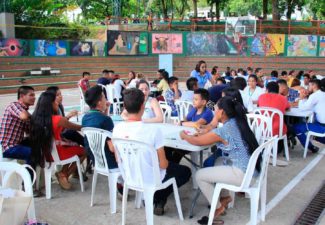
More than 50 young people participated in “Days of Hope in Caquetá”, a creative activism event for the conservation of the Colombian Amazon, driven by Landscape of Hope, Dejusticia, PID Amazon, Red Cross and Tell.
Read MoreEnlaza Venezuela arrives on October 2nd to the Museum of Modern Art of Bogotá
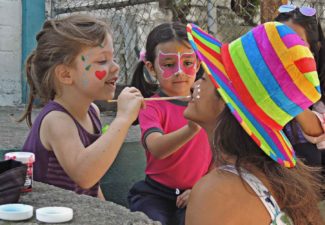
This will be an event that will show attendees the different paths that exist to support organizations that continue to work to transform the situation in Venezuela.
Read MoreWorkshop on creative activism Days of Hope is coming to Caquetá on the 21st of September
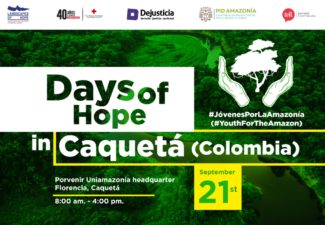
Dejusticia, PID Amazonía, the Red Cross Bogotá and Tell are getting together in Florencia to hold the first event of this international initiative that combines art and social mobilization.
Read MoreAttention! Job Opportunity at Dejusticia

Dejusticia is seeking a dynamic International Area Director who will both lead and work alongside the team to ensure the efficient functioning of the international area in its multiple tasks.
Read MoreSantrich Case: Dejusticia Defends and Respects the Autonomy and Independence of the Special Jurisdiction for Peace (JEP)
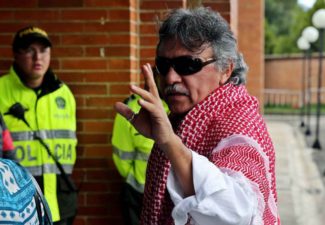
In the face of this controversy, Dejusticia calls on the Appeals Section (Sección de Apelaciones) of the JEP to clarify the special rules on evidentiary matters which apply to the guarantee of non-extradition.
Read MoreThe Colombian government has failed to fulfill the Supreme Court’s landmark order to protect the Amazon

One year ago, the Colombian Supreme Court declared the Colombian Amazon a subject of rights, ordering the government to take measures to preserve it by curbing deforestation. However, the government has not taken sufficient action; meanwhile, threats to the rainforest continue to grow.
Read MoreJoin our Petition in Change.org: We want zero deforestation in the Amazon
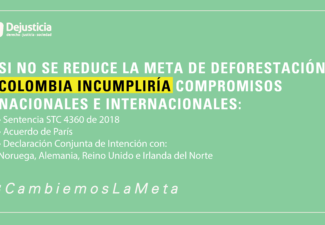
We, the 25 children and youth who won the first case in Latin America involving climate change and future generations, met with experts and civil society organizations in Colombia to ask our Congress, #LetsChangeTheGoal on deforestation that President Iván Duque proposed in the National Development Plan (NDP) 2018-2022.
Read More#LetsChangeTheGoal: We ask for a change in the deforestation target proposed in the National Development Plan

Civil society organizations sent a letter to Congress asking that the committee in charge of the National Development Plan change the indicators of deforestation results in Colombia.
Read MoreLeading Human Rights Organizations Support a Democratic, Non-Violent Solution to Venezuela’s Crisis
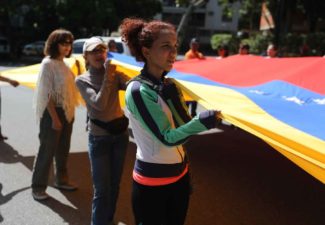
International Community Must Advance a Democratic, Non-Violent Solution to Venezuela’s Crisis.
Read More25 Voices against Deforestation: Finalists for the Children’s Climate Prize

The prize, which was awarded this 20th of November in Stockholm (Sweden), sought to highlight youth-led initiatives across the globe aimed at confronting the challenge of climate change.
Read MoreA year after the plebiscite, we learned the hard way
We learned the hard way about a country with very few bridges between different sectors. It is still necessary to defend the progress of the Peace Agreement: it is a remarkable success that today, there are 7,132 fewer weapons in our country, and that in the last ten months, there have been no registered victims from FARC actions.
Read MoreThe art of disagreement
Opening to disagreement entails exposing yourself to opposing ideas and contemplating the possibility of being persuaded. It does not mean that it is comfortable, but it is necessary to build a society in peace.
Read MoreWhat If Colombia Does Not Fulfill Its Promise to the FARC?
Colombia has a unique opportunity to build a future without an armed conflict. However, the statistics are against Colombian success, since 45% of the peace accords signed between 1989 and 2004 failed within the first five years of implementation. Therefore, there should not be additional destabilizing factors such as a breach of agreement.
Read MorePublic university
Reflections on public university in light the 150th anniversary of the National University of Colombia.
Read MoreThe Special Jurisdiction for Peace (JEP)
Despite all of its flaws, the Selection Committee made the best selection of judges for a high court that has been made in Colombia for decades. And we have a JEP that, given its integration, has all the capacity to achieve a worthy legal closure to our long and painful war.
Read MoreIt was to be expected
What is happening today in Colombia’s Judicial Branch was to be expected. It is a worrying trend in a country that requires more than ever a strong and reliable administration of justice for peace.
Read MoreLessons of the Special Jurisdiction for Peace
We do not have to look far to find immediate reasons against clientelism in justice. The judge selection for the Special Jurisdiction for Peace (JEP) has just given us two lessons that should be applied throughout the judicial system.
Read MoreParamilitary homophobia in San Onofre
In Sucre, the Montes de María paramilitary bloc forced gay men to star in boxing fights, only to publicly humiliate them. This is proof of why the peace process and its implementation should have a gender focus.
Read MoreCulture saves lives

It is not enough to say that cultural industries are important because they can generate dividends and jobs. In the end, it is not an exaggeration to say that art and culture can save lives.
Read MoreTocqueville’s recipe
Judicial reform is of little use as long as there are no profound changes in judicial habits and, more specifically, in the moral integrity of magistrates.
Read More