


Issue-Transitional Justice
Peace without indigenous or Afro-Colombian people
Through the fast-track in Congress, the implementation of the peace agreement is leaving out ethnic peoples. Long before there was a table in Havana, the peace labs were the territories of the Nasa in Cauca, the Wiwa’s Sierra or the black communities of the Pacific, who refused to take arms or left in the middle of guerrilla and paramilitary violence and state stigmatization.
Read More“Fast” but not “fat track”
The government seems to seek to convert the so-called fast track (“fast track”), into a kind of fat track (a “thick track”). At least that is the impression that leaves this idea of using it to approve constitutional reforms, such as mandatory voting or closed election lists, which may be good, but do not have a clear link with the Peace Agreement.
Read MoreThe selection of the Justice of Peace
With the march of the members of the FARC to the selected zones and the sessions in the Congress that have been integrating the agreement to the Colombian legislation, the Peace Agreement becomes a tangible reality. Not without uncertainties and without much bullying.
Read MoreEnough is enough!
In the last two years, every three days on average, a social leader or human rights defender was murdered.
Read MoreFrom guerrilleros to forest rangers
The end of war, as war itself, has paradoxical effects on nature. The most well-known impacts are the destructive ones: the poisoning of rivers through illegal mining that has financed guerrillas and paramilitaries alike; the contamination of soil due to the bombing of oil pipelines by the ELN, the rents imposed by FARC for coca crops in national parks, the forever dried-up wetlands by paramilities who cultivated palm.
Read MoreThe politics of remembering: A yellow house, snipers and civil war

In the midst of a busy traffic intersection, Beit Barakat, or the Barakat House, is an assuming edifice. Most Beirutis pass it by every day without knowing that behind its bullet hole-riddled yellow exterior lie almost a century of memories and a continuing struggle
Read MoreCommand responsibility
The so called “command responsibility” is a technical topic that generates perplexities even among experts. But it is really important since the legitimacy of the special peace jurisdiction (JEP) depends greatly on the topic being adequately resolved.
Read MorePeace without participation?
Something paradoxical is happening with citizen participation after the end of the war with FARC. Those who initially opposed the plebiscite but ended up winning, now suddenly embrace participation to claim that the peace accord is legitimate. Instead, those who supported the plebiscite and promoted participative democracy through the years, seem to be defensive after the October 2nd surprise.
Read MorePeace for women
The biggest challenge of 2017 is to consolidate peace. The agreement between the Government and the FARC promises to promote comprehensive rural reform, a process of democratic openness, a system that guarantees the rights of victims of armed conflict and some solutions to the problem of illicit drug use. Promises that should materialize with a gender approach, which came to the Agreement thanks to the persistence of the social movement of women and remained in it, despite having been misrepresented during the campaign of the plebiscite.
Read MoreAntidemocratic referendums
Days after the Brexit vote, the economist Kenneth Rogoff publicly opposed referendums and plebiscites like the British one on the European Union or the Colombian one on the peace accord.
Network of Land Restitution Monitoring Organizations Support Territorial Rights and Restitution Policy
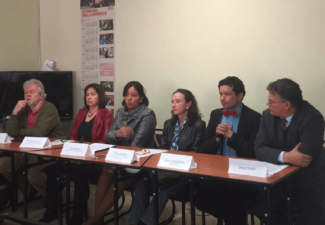
The organizations and people who make up this Territorial Rights and Land Restitution Monitoring Organizations Network express out general support for the territorial rights and land restitution policy.
Read MoreImpunity for Sexual Violence Associated with the Armed Conflict Persists

This is the conclusion of the Sixth Monitoring Report of the Constitutional Court’s Ruling 092 of 2008 and Ruling 009 of 2015.
Read MoreOpen Call for Applications until March 16th
Open to professionals working for public institutions and NGOs who work on implementing land restitution processes.
Read MoreIs a Plebiscite or a National Constituent Assembly the Right, Viable, and Convenient Mechanism to Put the Peace Agreement to a Popular Vote?

Rodrigo Uprimny’s intervention in the National Forum “End of the Conflict” and “Popular Vote Mechanisms, Implementation, and Verification”.
Read MoreWhy Are the Regulations of the New National Development Plan Regarding Paramos and Development Projects of National Strategic Interest Unconstitutional?

With six votes in favor and two against, the Constitutional Court ruled that the article of the National Development Plan that permits mining in paramos is unconstitutional.
Moreover, with a 5-3 vote, the Court decided that victims’ rights to land restitution supercedes Development Projects of National Strategic Interest.
In August 2015 Dejusticia intervened in this litigation arguing these measures’ unconstitutionality.
Read MoreWhat Happens in Colombia Affects What Happens in Havana?

Dejusticia and the Konrad Adenaur Foundation held a coffee and debate that began with that question. Here are the results.
Read MoreOrganizations Request Commitment to the Elimination of Gendered Violence in Habana

The Gender Subcommission invited ten human and women’s rights organizations to meet in Cuba.
Read MoreInfographic: Women and Peace

Find here the agreements reached in the peace process with a gender perspective.
Read More2nd Women and Transitional Justice Meeting

From the 27th to the 28th of August Women’s and Victims’ Organizations will discuss the Truth Commision’s challenges and proposals.
Read More“One realizes that what has been done in Colombia isn’t so terrible”

Leonarda De la Ossa, Activist from Montes de María, talks about her experience in the Action-Research Global School.
Read More