


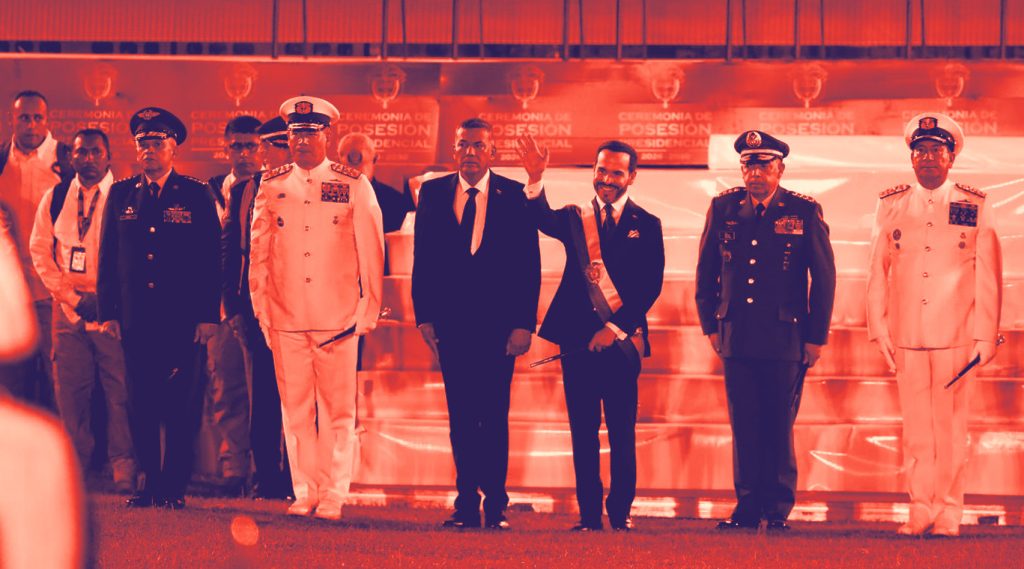
“The Latin American political landscape has undergone a marked shift to the right.” | EFE
Colombia Changes Course: How Might the New Government Redefine Colombian Foreign Policy and the Political Balance in Latin America?
Por: Christy Crouse, Sofia Forero Alba | September 3, 2026
The arrival of the new Colombian government is not merely a democratic transition. It represents a redefinition of the political project and the role Colombia seeks to play on the international stage, whose implications transcend national borders and are part of a broader reconfiguration of the Latin American political landscape.
Over the past decade, various Latin American countries have undergone rapid shifts in political orientation. These processes stem, in part, from growing public discontent over persistent problems such as inequality, insecurity, corruption, and the limited capacity of governments to provide sustained solutions. The Latin American political landscape has experienced a marked shift to the right, with the rise of conservative movements that have capitalized precisely on that discontent.
In this context, the transition from the administration of Gustavo Petro to that of Abelardo de la Espriella transcends domestic politics. Beyond the redefinition of the national political agenda, the change in government raises questions about the role Colombia will play in Latin America and the Global South, as well as about the continuity or transformation of its international strategy adopted in recent years.
From Progressivism to a New Political Project
The priorities a government sets domestically shape the way a country defines its alliances, exercises regional leadership, and projects itself on the international stage. In this sense, the transition from Gustavo Petro’s administration to that of Abelardo de la Espriella entails much more than a mere change in power: it represents a shift in the development model and in the conception of the state’s role.
The Petro administration promoted a project that integrated the reduction of inequalities, the expansion of rights, the implementation of “Total Peace,” and the energy transition as pillars of economic and social transformation. From this perspective, the state was expected to take an active role in correcting structural inequalities and promoting agendas such as climate justice and the protection of human rights—albeit with mixed results.
The new government proposes a different direction. Its agenda prioritizes security, economic growth, private investment, and competitiveness as the main drivers of development. This implies a greater emphasis on the military’s regaining of territorial control and the fight against organized crime, as well as a review of certain policies related to the energy transition and state intervention in the economy.
Beyond programmatic differences, this shift reflects a redefinition of national priorities and of the development model that will guide government action in the coming years. This transformation will not only affect domestic policy but will also shape the way Colombia seeks to position itself in Latin America, redefine its strategic alliances, and participate in international debates such as the energy transition, regional security, and the role of the Global South in global governance.
The Redefinition of Colombian Foreign Policy
During Petro’s tenure, Colombia sought to project itself as a voice of the Global South and increase its diplomatic autonomy. It took an active role in the climate debate and the protection of the Amazon; adopted critical stances toward Israel’s actions and strongly defended the Palestinian cause; maintained a very tumultuous—though not severed—relationship with the United States; and sought to revitalize Latin American dialogue and strengthen regional forums. In multilateral forums, Petro’s speeches sometimes bordered on the inflammatory, but, in general, Colombia participated actively and productively to advance international agendas addressing collective challenges.
The new administration appears to be heading in the opposite direction. It is highly likely that there will be a different approach toward Washington and that the United States will play a more influential—even decisive—role in Colombia’s domestic and international agenda. Trump openly supported ADLE’s candidacy, and Marco Rubio has stated that he wants to focus the bilateral relationship on “advancing regional security cooperation, ending illegal migration to the U.S., and strengthening our economic ties.” In addition to these overtures from the United States, ADLE is a U.S. citizen and has said he admires Trump and his policies. On August 12, 2026, Colombia joined as the 19th member of the U.S.-led “Shield of the Americas” and authorized the U.S. to conduct military operations on its territory; this represents a significant shift in the country’s security and foreign policy.
There will also be a realignment of the relationship with Israel; ADLE has already confirmed that one of the first decisions of its foreign policy will be to open the Colombian Embassy in Jerusalem. According to the statement, this decision is based on strengthening “the country’s presence in areas considered priorities for national interests.” The government also decided to break with the international consensus, violate international law, and align itself with the United States by recognizing Israeli sovereignty over the Golan Heights. This decision is no small matter; it represents a total departure from Colombia’s longstanding tradition of respecting international law.
It is also very likely that there will be a reassessment of Colombia’s leadership in multilateral forums—if not a complete withdrawal from them—especially on key issues from the previous administration, such as the fight against climate change.
ADLE has already announced that Omar Bula Escobar will be the new Secretary of State for Foreign Affairs. Bula has a long diplomatic career spanning more than 20 years, particularly with the UN (in countries such as Ecuador, Sudan, Italy, and Egypt). He has been a professor, writer, and lecturer whose views align “with the U.S. MAGA Trumpism.” He has supported ADLE since the beginning of its 2025 campaign. This appears to be an appointment rewarding loyalty. Furthermore, Bula’s father was ADLE’s godfather at his baptism. His views are radical and at times conspiracy-theory-driven; while seeking to ally himself with Trump and the U.S., he aims to distance himself from the globalist agenda.
With Bula in this position of power, we can expect the U.S. to influence Colombia’s agenda in many ways, to forge closer ties with other right-wing governments—with a greater emphasis on security and foreign investment—and to promote propaganda against globalist policies and the left.
Colombia in the Latin American Political Realignment
Colombia’s transition coincides with a realignment of the political balance of power in Latin America, marked by a clear shift to the right. In recent years, right-wing and far-right governments have gained ground in several countries in the region. Argentina, with Javier Milei; Ecuador, with Daniel Noboa; Chile, with José Antonio Kast; and more recently Peru, with Keiko Fujimori, reflect a trend that now also includes Colombia. This shift is reshaping debates on development models, security strategies, the role of the state, and the direction of foreign policy.
While each electoral process is shaped by specific national dynamics, various analyses agree that this regional shift can be explained by shared factors: insecurity, the persistence of deep social inequalities, and public disillusionment with governments perceived as incapable of providing effective solutions. In this context, security and economic stability have supplanted other issues that dominated the regional agenda over the past decade, favoring political agendas that promise greater state authority, crime control, and the restoration of market confidence.
Rather than merely confirming a regional trend, the Colombian case allows us to observe its potential effects. As one of Latin America’s leading economies, a historic ally of the United States, and a strategic actor in issues such as the Amazon, migration, and hemispheric security, a shift in Colombia’s political orientation has the potential to influence the region’s political balance. Likewise, it may influence the functioning of regional integration mechanisms, coordination in the face of shared challenges—such as migration, security, and climate change—and Latin America’s ability to project a more cohesive voice on an international stage marked by growing geopolitical tensions.
Institutions as a Key Tool for Ensuring the Balance of Power, Political Alternation, and Democracy
While the arrival of the new administration marks a new phase for Colombian foreign policy, the debate should not be limited to the ideological orientation of the current government. The region’s recent history demonstrates that democracies are, by their very nature, settings for political alternation and change.
The debate must also focus on the capacity of its institutions to ensure that transitions occur within the rule of law, with respect for electoral rules, the separation of powers, and fundamental freedoms. Brazil’s recent experience is illustrative: despite strong political polarization, challenges to the electoral system, and attempts to disregard the results of the 2022 elections, the coordinated action of institutions such as the Superior Electoral Court, the Federal Supreme Court, and other state entities made it possible to preserve the constitutional order and ensure a democratic transition of power between governments with polarizing ideologies. Rather than an exceptional case, Brazil demonstrates that democratic resilience depends on having institutions capable of correcting potential authoritarian drifts.
In this regard, Colombia’s future will depend not only on the direction of the new government but also on the capacity of its institutions to preserve the democratic balance as the country redefines its place in a Latin America undergoing transformation.
