


Dejusticia refrains from commenting on selection of Special Jurisdiction for Peace (JEP) members
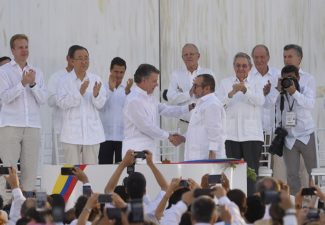
In order to maintain our autonomy and preserve the capacity for independent reflection, we will not comment on the applicants to the Integral System of Truth, Justice, Reparation and Non-Repetition.
Read MoreRural reform decree to resolve historic debt with peasants

Terrible conditions in the countryside and lack of access to land are linked to the armed conflict. Point one of the Peace Agreement, which is under study by the Constitutional Court, addresses these issues. Dejusticia presented an intervention supporting most of its content.
Read More#VenezuelaBienvenida, a call for solidarity

With this initiative, we want to bring Colombians closer to the stories of the Venezuelans who migrated to our country and the deep economic and humanitarian crisis that Venezuela is experiencing.
Read MoreA Colombian woman appeals to the government for help locating her son arbitrarily detained in Venezuela
Ramona Rangel reports that on July 30th, the [Venezuelan] Bolivarian Intelligence Service took her 24-year-old son, Juan Pedro Lares, from his home in Venezuela. 11 days later, and still without any updates regarding his whereabouts, Rangel is asking the Colombian Embassy in Venezuela for help with her search.
Read MoreThe national government geographically isolated Chocó

We intervened to support a tutela that requires the government to pave the
Quibdó-Medellín and Quibdó-Pereira roads: a promise that has historically been unfulfilled.
It is necessary to consolidate the JEP as soon as possible: press release
Dejusticia, together with other civil society organizations and academics, celebrate the definitive step of the FARC-EP’s abandonment of arms to end the conflict and stress the importance of consolidating the Special Jurisdiction for Peace as the next key step.
Read MoreThe Constitutional Court has the last word to save the Ciénaga Grande of Santa Marta
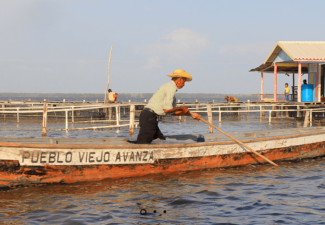
The environmental crisis of this ecosystem led fishermen to pursue a legal battle that reached the High Court. In this intervention, we support their demand that environmental authorities take urgent measures to stop the disaster and thus, protect their rights to healthy environment, dignified life and work.
Read MoreThe migratory wall facing refugees

What is it like to migrate to Colombia and the United States? The stories of Johan and Sonia, two of the 65.6 million people who have been forcibly displaced around the world.
Read MoreColombian lawyers reject Constituent Assembly in Venezuela
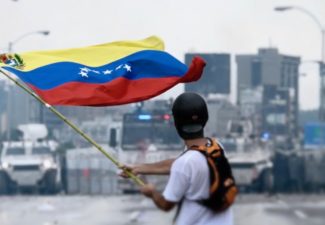
Through a letter, lawyers point out that this initiative, which will take place this Sunday, July 30th, is unconstitutional and essentially an arbitrary decision by Nicolas Maduro’s government.
Read MorePrison is not the only sanction in transitional justice mechanisms

César Rodríguez argued that the Comprehensive System of Truth, Justice, Reparation and Guarantees of Non-Repetition is in harmony with the Constitution. Regarding different penalties, he affirmed that international law discusses effective sanctions, not jail.
Read MoreAn immature Constituent Assembly
The Constituent Assembly convened by Maduro does not seek to forge a pact between opposing forces, but seeks to crush the opposition through an antidemocratic mechanism, which is also unconstitutional. The international community and even authentic Chavismo should oppose it.
Read MoreMilitant hope
Hope should not only be cautious but militant: young people around the world should mobilize against politicians like Trump who are willing to damage the world in which they, the young, will live tomorrow.
Read More21st century socialism, dictatorship or rebellion?
The Venezuelan government is advancing in its plan to dismantle the 1999 Bolivarian Constitution. And it is the 21st century rebels who defend democracy and human rights against the heirs of 21st century socialism who abdicated their democratic promise.
Read MoreClarifications on the fast-track process
Even though the Court’s sentence on the fast-track process is legally wrong and makes the implementation of the Peace Accord more difficult, it is important to understand its scope. A poor understanding of the sentence could increase its negative impact.
Read MoreFrantz and war
Frantz, a film by the French director François Ozon, deals with the absurdity of war and the terrible fate of societies entangled in it.
Read MoreThe Constitutional Court and a minimalist peace
The Constitutional Court’s ruling on the fast track process could mean a minimalist peace for Colombia: a peace that brings the end of the FARC without the reforms needed to build a modern state.
Read MoreMore opportunities and less jail for women with drug offenses
93% of these women are mothers, 52% are head of household, and many have not finished high school; that is, they are poor women. Although the Peace Agreement contemplated a different criminal treatment for these cases, to date no bill has been filed before Congress.
Read MoreThe Court on the fast-track process
The Court’s ruling on the fast track procedure could be an opportunity to achieve greater democratic legitimacy for the peace agreement, as the new rules of the game demand the construction of stronger consensus in Congress.
Read MoreHateocracy
In Colombia, hate seems to add more than in other latitudes. If anything has determined Colombian politics in recent years, it is the visceral hatred that President Uribe exercises day after day against President Santos.
Read MoreAccess to ICTs: Is it just about giving power to the people?

Citizens’ enfranchisement is not the only empowerment that will come alongside universalized access to information technology. Indeed, total connectivity will also empower data collectors. But as the digital divide has not yet been closed, there is still time to look for tools to cope with the informatics power that governments and Internet platforms will be able to acquire.
Read More