


The selection of the Justice of Peace
With the march of the members of the FARC to the selected zones and the sessions in the Congress that have been integrating the agreement to the Colombian legislation, the Peace Agreement becomes a tangible reality. Not without uncertainties and without much bullying.
Read MoreReasons for mandatory voting
The question about mandatory voting resurfaces with the Government’s proposal to include it in the package of reforms derived from the peace agreement. The discussion is deep, has occurred in many countries and involves arguments and studies that must be considered with pause.
It’s not Trump, it’s the United States: a history of racism and xenophobia
The idea of nation is beautiful. But I believe, as a US citizen, that as long as fear subsists, the idea will remain just that.
Read MoreTrampling on rights by judicial order: the risks of presidential appointments of judges in a personalist era
Since Trump ascended to the seat of Lincoln, political personalism has taken over the most powerful nation in the world. Now with the selection of the ultraconservative Neil Gorsuch as nominee to the Supreme Court, the politicization of justice is sharpened, and so is the scrutiny of the system to designate judges to the high courts. Read the…
Read MoreA weak and temporary court does not serve peace
To guarantee a proper normative implementation of the peace accord, we need an independent and very strong Constitutional Court both in the political and in the technical sense.
Read MoreEnough is enough!
In the last two years, every three days on average, a social leader or human rights defender was murdered.
Read MorePrivate life in a public way
The new Police Code confuses privacy with staying at home and targets the right to privacy.
Read MoreFrom guerrilleros to forest rangers
The end of war, as war itself, has paradoxical effects on nature. The most well-known impacts are the destructive ones: the poisoning of rivers through illegal mining that has financed guerrillas and paramilitaries alike; the contamination of soil due to the bombing of oil pipelines by the ELN, the rents imposed by FARC for coca crops in national parks, the forever dried-up wetlands by paramilities who cultivated palm.
Read MoreA decade of dignity
On February 7th, 2007, the Constitutional Court ended with the legal apartheid against same-sex couples by recognizing their constitutional protection and extending the patrimonial protection under the same conditions as heterosexual couples.
Read MoreWhy people do not like the new Police Code
Colombia has a new Police Code. The law that created these new rules for “coexistence” has 241 articles, was drafted by the Ministry of Defense in the company of the same National Police and had the approval of Congress. Its spirit, the document says, is “preventive.”
Read MoreIncreasing support by health organizations for the sugary drinks tax

We presented a tutela in defense of the Great Ciénaga of Santa Marta

On November 10th, we presented a tutela action regarding the environmental degradation situation that affects the Great Ciénaga of Santa Marta. The ciénaga is a strategic ecosystem composed by a collection of lakes and wetlands, declared Biosphere Reserve by UNESCO and protected by the RAMSAR Convention.
Read MoreDejusticia publishes document with legal reasons in favor of the sugary drinks tax
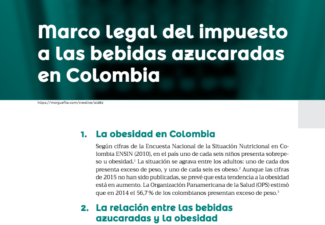
Ad portas of a
tax reform, Dejusticia publishes a policy paper on the viability and importance
of the tax on sugary drinks as a public health measure to disincentive
consumption.
Press Release for the General Public and the Dialogue Table in La Habana
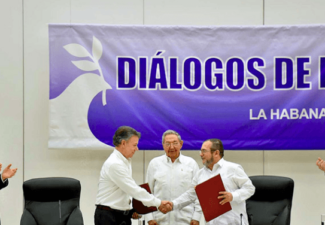
The signatory organizations address this statement to the general public and the Dialogue Table in La Habana, in order to present legal and political conciliatory points on certain issues of the Peace Agreement signed by the Colombian Government and the FARC EP on September 26th, 2016.
Map of proposals of the NO spokespeople
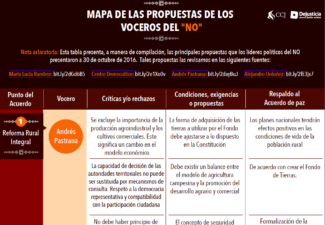
This table, elaborated by Dejusticia and the Colombian Commission of Jurists, compiles the main proposals of the political leaders of the NO.
Read MoreDejusticia intervenes at UN on transnational corporations and human rights
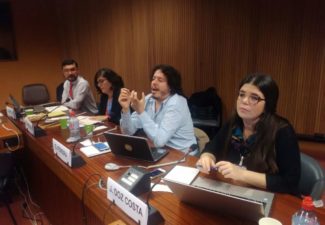
This week (October 24-28), the 2nd Session of Open-ended Intergovernmental Working Group on Transnational Corporations and Human Rights is meeting and discussing a binding legal instrument.
Read MoreIntensive Course on Economic, Social and Cultural Rights: Latin America in a Global Context Begins
The course brings national and international scholars in the area, as well as 23 participants to learn and build knowledge from the Global South.
Discussion forum: The Future of Social Rights

As part of our Intensive Course on Economic, Social and Cultural Rights: Latin America in a Global Context, we invite you to an event on October 25th on the future of socials rights. The event will be livestreamed.
Read MoreThe Constitutional Court decides on popular consultation processes in favor of public participation
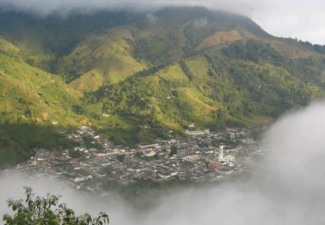
The Constitutional Court recognizes that popular consultations on mining are legal and that municipalities can prohibit mining in their territories.
Read MorePijao, the “slow” town that challenges the mining sector

In this article by El Tiempo, Laura Sepúlveda explains how Dejusticia supported the formulation of the tutela that Pijao residents submitted to get a popular consultation process on mining affairs.
Read More