


The Dividing Line between Opportunism and Good Business
Alejandro Reyes revived the land restitution debate: how to determine which land was voluntarily sold, despite having taken place in areas influenced by the armed conflict.
Read MoreArgentina and Colombia Go after Economic Actors in Contexts of Violence
In recent weeks there have been two interesting development in the movement to demand responsibility from economic actors that support serious human rights violations in contexts of conflict and repression, such as the case of Chiquita Brands’ support to Colombian paramilitaries, or Argentinean companies that financed and supported the military regime.
My Person of the Year: Fabiola Lalinde
My person of the year is Fabiola Lalinde.
Read MoreThe State of Peace
Following the hangover of the holidays, and for some, the celebration of coming into office, today they wake up with tasks at hand those who for the next four years will lead the destinies of the country at the regional level.
Read MoreNew Year’s Present for Large Estate Owners and Investors
The economic model for rural development proposed by the Government and approved this month by Congress favors the concentration of land use by large investors.
Read MoreStraw Man of Impunity?
Human Rights Watch’s critiques of the Peace Special Jurisdiction (JEP) agreed upon by the FARC and the Goverment are important and should be debated. However, it is an unacceptable exaggeration to conclude that the agreement is a pact of impunity, as its spokesperson José Miguel Vivanco said.
Read MoreTransitional Justice and Public Forces
This week, with President Santos’ announcement about the characteristics of the special jurisdiction that would apply to civilians and members of the armed forces charged with crimes related to the armed conflict, it completed the puzzle of justice for peace.
Read MoreThe Constitutional Court: Between the Sacred and the Profane
The ban on sharing property in the first two years of a free union seems to be the result of religious influence on the Constitutional Court.
Read MoreThe Agreement about Victims: Peace with Justice
Despite the foreseeable criticism it has received, the agreement about justice and victims that was reached this week in Habana is a gigantic step in the path to achieving peace in Colombia. Why?
Read MoreHuman Rights in Times of Austerity, Who Should Answer?
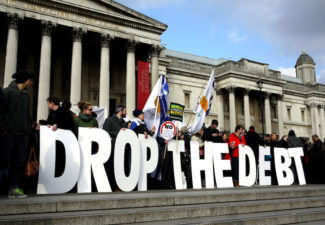
The adjustment policies that resulted from the Troika negotiations have meant a heavy weight that, as in Aeschylus’s tragedy, have fallen relentlessly and ruthlessly on the human rights of the Greek people.
Read MoreThe political balance of the reform to the OAS system of human rights
“Despite almost two years of reflection and discussion, countries in the region arrived with no agreement to the General Assembly of the OAS called to define the future of the Inter American Commission on Human Rights(IACHR).” This was how different media outlets headed their coverage of the marathon meeting of chancellors organized during March 22nd in Washington D.C.
Read MoreLaw, love and politics in egalitarian marriage
While same-sex marraige is prevailing in the United States, the legislation on the topic is staggering in the Colombian Congress.
Read MoreIs God secular
It seems natural that does of us who don’t believe in gods or are not particularly religious support secularism, this is, the principle according to which the colombian State should be separated of religions and be neutral in this field.
Read MoreThe boicot to Los Tres Caínes and the independence of the media
The strategy that intends that advertisers withdraw their advertising cannot be seen as a threat to the independence of the media.
Read MoreEngines and rural poverty
Government is betting on mining in the countryside. However, is this the best way of improving the life quality of its inhabitants?
Read MoreThe power of the jesuits
The arrival of the jesuit Jorge Bergoglio to the head of the Catholic Church has put the company of jesus on the spotlight. Some interpret this as the high point of the influence of the jesuits: the incarnation in the white pope of the power that already exercised the black pope, the world superior of the power of the Company.
Read MoreWhat is the current state of the land restitution process?
It is about time to make a balance of the land restitution process, which recognizes the rights of victims that have been subject of land dispossession. There are important advances, although these are taking place at a slow rate. There are four obstacles that should be removed as soon as possible.
Read MoreIs the pope important to the catholics?
The questions seems stupid, since the designation of a new pope or his visit to any place is always a big event, even when it is in countries of a small catholic population. How could then be the pope secondary to the catholics if he is a notable character even for those that are not catholics?
Read MoreThe Law and Voluntary Interruption of Pregnancy
The State Council’s decision to nullify Decree 444 of 2006 isn’t surprising. It also doesn’t change the current regulation on access to the voluntary interruption of pregnancy (VIP) in the three cases where it has been recognized by the Constitutional Court.
Read MoreTake the water of the fish
On the attempts of reform of the Interamerican Comission of Human Rights
Read More