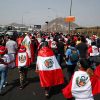
“Rural communities speak out in their own voice.” | EFE
Farmers and Agrarian Reform: the Invisible Protagonists of a Global Debate?
Por: Carlos Quesada | June 25, 2026
“Nor is my invisibility exactly a matter of biochemical accident to my epidermis.
That invisibility to which I refer occurs because of a peculiar disposition of the eyes of those with whom I come in contact.”
Ralph Ellison
To address humanity’s most pressing problems, leaders have established global forums and held multilateral events where academic experts, government representatives, and members of civil society make remarkable efforts to tackle them. However, despite attempts to make these dialogues inclusive, until very recently, small farmers were completely absent from these types of discussions. From certain perspectives, there were few incentives to involve them in global conversations: they were viewed solely as predators, polluters, or unproductive individuals with little political agency and often associated with various forms of illegality.
Agrarian reform was also excluded from multilateral forums and global bodies. In the final decades of the 20th century, many reduced it to an approach focused on agricultural industrialization, portraying it as an enemy of conservation. To carry out agrarian reform, it was believed, one had to clear the forests, mechanize plowing, and purchase pesticides. Politically, agrarian reform was associated with authoritarian regimes; it was claimed that only dictatorships were capable of redistributing land, overlooking the importance of these reforms for the consolidation of democracies and democratic reform initiatives. These prejudices marginalized the discussion on agrarian reform and rendered invisible its links to the conservation of agrobiodiversity and political democracy.
With the 2018 United Nations Declaration on the Rights of Peasants, these circumstances began to change, at least in part. Today, more and more spaces are opening up where the issue of the peasantry is central; and where spaces are still closed off, peasant communities are speaking up to advocate for their own interests. This seems to confirm that the international invisibility of the peasantry was never inherent to them, but rather a bias of international actors. In the hope that agrarian reform will follow the same path—from invisibility to the center of global discussion—in this edition of the international newsletter we wish to draw attention to the role that agrarian issues should play in global debates.
In the first of our articles, Carlos Olaya provides a careful and engaging overview of the limitations and opportunities presented by ICARRD+20—the global conference on agrarian reform held in February of this year in Cartagena, Colombia—to spark a global conversation on agrarian reform.
In the second article, a collaborative piece featuring José Ignacio Torres, a master’s student at Sorbonne University, we attempt to examine some of the changes taking place in the landscape of international cooperation with Colombia following China’s emergence on the regional scene. The article examines the role of cooperation in the agricultural sector and explores the relationship between Chinese cooperation programs and respect for human rights.
Just as the invisibility of the peasantry was never an aspect of the peasantry itself but in the eyes of those who looked upon them, we hope these pages will help cultivate a different perspective—one that understands the crucial role of agrarian reform within shared global concerns.