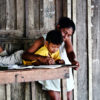
ACIMVIP is a strong organization that derives its strength from its guiding purpose: to improve the living conditions of the Inga people of Villagarzón. |
The struggle of ACIMVIP: Sacha Muiu and the protection of the territory
Por: Paula Andrea Valencia Cortés | July 6, 2023
Within the majestic Amazon rainforest is Villagarzón, a municipality in the foothills, located in Putumayo. At first glance, the gigantic mountains and the humid climate catch my attention, where indigenous people, peasants, some public officials from the institutions created by the Peace Accord, and people in the uniforms of large extractive companies converge. All with the same friendliness, but with very different worldviews.
A few blocks from the urban center is the Association of Inga Indigenous Councils of the Municipality of Villagarzón Putumayo (ACIMVIP), which aims to protect and improve the conditions of the Inga people of this municipality. ACIMVIP also works for the defense of the territory and the cultural and economic strengthening of 11 indigenous communities that bring together 766 Inga families: more than 2,500 people.
The Association, led by Carlos López for more than eight years, has eleven governors who work hand in hand with Ginny Alba – the Human Rights coordinator –, Luis Jansasoy – the elder in charge of self-government –, the Taita Vicente Jacanamijoy – the spiritual guide –, and others who, despite not being present, gave their lives for this purpose, such as Robinson López, who died from Covid-19 while leading different projects to strengthen the organization.
In order to support some of ACIMVIP’s tasks for its participation in the case on human rights violations of indigenous peoples that the Special Jurisdiction for Peace (JEP) is advancing, Ginny, elder Luis, and members of the Indigenous Guard took me to see the results of their hard work. With them, we left the center of Villagarzón to get closer and closer to the jungle.
At the beginning, it is easy to be dazzled by the contrast of colors: the light blue of the clear sky with few clouds, and the deep green of the jungle. After a while on the road, you can see that the trees begin to lose strength, as if their green, striking at a distance, was another victim of the war. Up close, the leaves look burnt, of a white color and a hoarse texture. Elder Luis, who knows his territory perfectly, explained to me that this weakening of the enormous trees is due to the spraying with the herbicide glyphosate, used in Colombia to stop the expansion of crops declared illicit.
Among the trees weakened by glyphosate, abandoned crops appear, full of weeds. These are harvests that are being damaged. With an ironic laugh, the elder says: “Many NGOs, along with the government, come to offer us ideas of what they call ventures. So, they convince us to use our territories to plant new species, like cacao. But these supposed businesses do not work, because no one buys the product.”
After this long and unencouraging journey, the weather begins to change: the air becomes light, the landscape turns green again and the leaves no longer look mistreated. We arrived at the Vereda Alto Alguacil, where the Tambo is, a sacred place for the Inga people where they perform Yagé ceremonies. With satisfaction and pride, elder Luis says that this is one of the territories that ACIMVIP has managed to protect. Although it seems enormous, Luis emphasizes that it is only a piece of the 32 thousand hectares that they have managed to safeguard.
Being able to enjoy this territory is a small example of ACIMVIP’s work in this region. They are proud, because the fight has not been easy. They have had to protect this territory from illegal armed groups and from NGOs that try to convince them to carry out other activities that are not suitable for the Amazonian soil. Despite the achievements in protecting the territory, the most vital concerns still persist: what to live on and what to eat. In the end, protecting the territories does not provide money to subsist.
In any case, with their own hands they have built solutions that never came from the State, nor from academia, nor from NGOs. This is the case of Sacha Muiu, a food processing plant created by ACIMVIP for the sustainable use of Amazonian species. There they transform the raw material that is abundant in the area into a product for commercialization. It seems like a dream, and it is. Sacha Muiu seeks to process moriche, also known as canangucha, an Amazonian fruit derived from a palm. The oil is used to restore the skin and to protect from the sun, as well as to make jams and even soaps and other products. Currently, the plant has the capacity to produce 500 liters of moriche oil per year for cosmetic purposes.
To do this, the Ingas begin by collecting and selecting the ripe fruits of the Canangucha palm and then taking it to Sacha Muiu, where the selection process is repeated by weight and quality. Subsequently, the fruit is pulped, that is, the seed, the skin, and the pulp are separated to continue with the dehydration. Then the pulp is placed in the sun, and once it is dry, it is passed through a press with a very thin cloth that manages to separate the saturated fats. After this process, the extra virgin oil and the fats that are used in the cosmetic industry are separated.

They still need to receive training to be able to access the international market and money to continue strengthening production. Photo: Juan Jojoa
As if that were not enough, Sacha Muiu has the legal permits for operation and commercialization, a forest and cultural management plan that allows the reforestation of the sacred sites of the moriche groves, a truck with a capacity of 8 tons, two pieces of equipment for the transformation of the pulp, and a website to promote its products.
It has not been an easy process. On three occasions, they have presented to Visión Amazonía, a program of the National Government that finances proposals from the indigenous and peasant communities of the country. From this program they managed to receive a first investment with which they have achieved all these advances. However, they still need to receive training to be able to access the international market and money to continue strengthening production. It is not an easy task, but little by little they are achieving their goals.
ACIMVIP is a solid organization, which derives its strength from the purpose that guides it: to improve the living conditions of the Inga people of Villagarzón. They have managed to consolidate themselves organizationally and have launched ideas with great potential for success that combine respect and protection of the Amazonian territory. In addition, the Association has managed to revive the hope, dreams, and goals of the Inga people in Villagarzón. Sacha Muiu, more than a processing plant, is the dream of a people of no longer depending on a State that has not taken them into account much and thus reaching a good life.
The children look with emotion at the new processing machines, the mothers and grandmothers talk about how they are going to collect the moriche to take it to Sacha Muiu, the fathers and taitas do not stop talking about how to get to the big cities for commercialization. The eleven reservations that the Association represents do not stop celebrating the productive project that will undoubtedly be a success. ACIMVIP has managed to protect the territory and give shape to the dreams of an entire community.

The Association has managed to revive the hope, dreams, and goals of the Inga people in Villagarzón. Photo: Juan Jojoa
(*) Researcher at Dejusticia
This article is part of the special #TejidoVivo, a product of a journalistic alliance between the Dejusticia study center and El Espectador.