


Home_Internacional
Intimately Political Conversations on Feminisms

The tapestry of our voices reveals questions, tensions, and trajectories that inhabit contemporary feminisms and that challenge not only women but all of humanity.
Read MoreInternational justice: as fragile as it is necessary

Is international justice effective? We analyze the fragility, lack of budget, and political tensions and global courts.
Read MoreWith judges on the chopping block, who will defend us?

With the global Rule of Law in decline, Latin America has become a political chessboard. Who protects us when judges lose their power?
Read MoreJustice in check, but not yet a checkmate

We analyze global attacks on judicial independence and the resistance of courts against rising authoritarianism.
Read MoreHow the U.S.’s Narrative Hurts Immigrants

This anti-immigrant narrative fits into the same broader framework of racism and discrimination that U.S. governments have used throughout history to promote fascist policies against other groups, particularly African Americans and Native Americans.
Read MoreCOP30: transitions, hope, and discontent

COP30 was the setting for discussions on the ‘transitions’ that are pending in a world that is changing due to the impacts of climate change.
Read MoreCOP30: when food came to the climate change negotiating table

The food transition is thus consolidating itself as a strategic axis of climate action, capable of articulating mitigation and adaptation objectives with the guarantee of the human right to adequate food.
Read MoreBeyond COP30: the dispute over a just transition in the face of corporate power

While international law raises the standard of state duties in the face of the climate emergency, corporate power, in the name of “competitiveness,” dissolves regulatory tools.
Read MoreOpen call for Global North fellowships 2026

This opportunity, for the second semester of 2026, allows for the exchange of tools and research-action strategies developed at Dejusticia, as well as the contributions of interns and fellows with their own experiences and those of their organizations.
Read MoreChildren defenders of human rights

The Constitutional Court of Colombia recognizes for the first time that children have the right and duty to defend human rights.
Read MoreColombian Democracy in the Streets
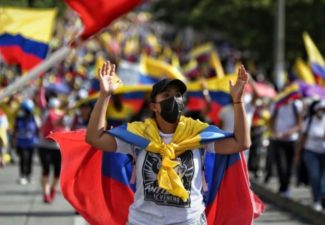
Confronted with the violence in the protests, the government and political leaders, as well as social leaders, must first promote the de-escalation, putting human rights at the center of the crisis management.
Read MoreFrom Snow Angels to a Humanitarian Emergency

If States like Texas with ample means to tackle climate change fail to do so, the world as a whole fails given that the planet loses momentum in the collective effort to become more resilient against this phenomenon.
Read MoreDespite Biden’s Victory, Authoritarian Populism Continues to Threaten U.S. Democracy
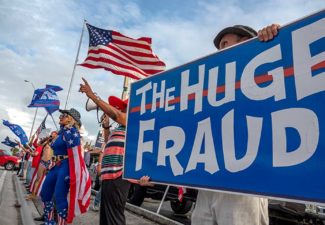
The Republican Party violates norms which protect democracy more frequently than 85% of other political parties leading democracies around the world. Their lack of commitment to these norms shows that the U.S. political system could be weakened even further if another antidemocratic leader comes to power.
Read MoreThe Peruvian crisis and abusive constitutionalism

The Peruvian Congress declared the vacancy or removal from office of President Martín Vizcarra, invoking Article 113 of the Constitution. The procedure appears to be formally appropriate. But the matter is more complicated than that.
Read MoreInternational Humanitarian Law and Victims of Child Recruitment as Targets of an Attack
An interpretation of the spirit of IHL, manifested in the principles of military necessity and humanity, as well as the IHRL standards applicable to children, should always prohibit the State from causing excessive death or injury. There is nothing more excessive than killing recruited children —vulnerable, discriminated against, and abandoned by the State— in order to gain a military advantage that could have been achieved through other means.
Read MoreDigital Transitions in Transitional Justice

The digitalization of transitional justice should not be seen as a long-term solution, as it can never replace the visceral dynamics of in-person human interaction and emotion, both essential in transitional justice processes.
Read MoreThe Human Rights-based Approach: The Pending Issue of the Migration Law
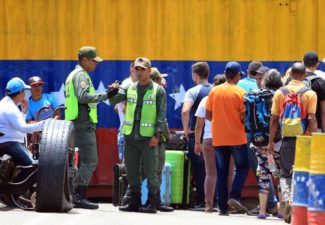
Although the Colombian government has implemented a series of measures to assist the Venezuelan population, this response has been sectorized and short-term in nature.
Read MoreThe Right to Have Rights: A Debate on Nationality in Colombia
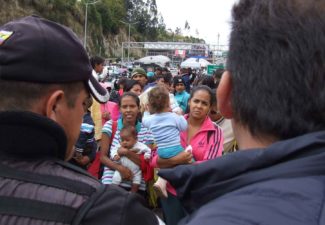
Over ten human rights organizations appeared before the Constitutional Court asking to adopt the definition of domicile contained in the Civil Code, as provided in the Political Constitution and Law 43/1993
Read MoreFrom repression to migration: The case of Rufo Chacón
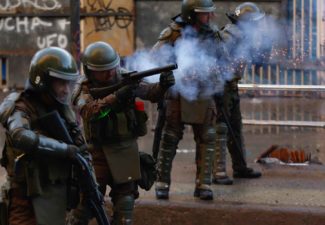
Rufo Chacón, in the company of his mother, is preparing to travel to Spain, where he will get the surgical intervention needed to improve his condition.
Read MorePrisons: What Force Can’t Do
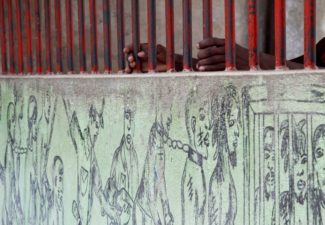
“Heavy-handed” policies on crime in many countries in the Americas have not only brought prisons to crises around the continent, but have also failed to reduce crime and recidivism. A more humane penitentiary system, not one of terror, seems to be the solution that our continent needs.
Read More