


Area-Global South & North Collaborations (Internationalization)
The Hungarian Case and its Anti-NGO Laws

One of the most sustained targets is civic space. Orbán’s government has invoked transparency and national sovereignty to justify a series of laws designed to suffocate independent civil society.
Read MoreThank You, Activists from the Global South! We have selected the new 2025 cohort of fellows
The next call for applications will open at the end of 2025 to form the cohort that will begin in mid-2026. Don’t miss the opportunity to apply!
Read MoreArgentina must protect social mobilization, not silence it
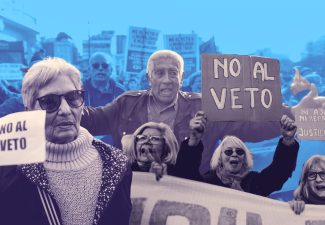
We express concern about the advance of authoritarianism in Argentina and its consequences for the entire region, and urge Latin American states to speak out in defense of democracy and the human rights of Latin American peoples.
Read MoreThe right to protest under threat: the situation in Peru
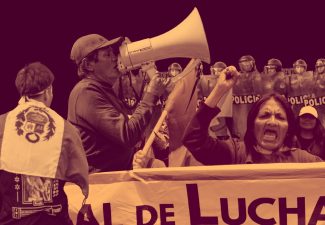
Peru faces a fractured democracy: violent repression, criminalization of protests, and exclusion of indigenous communities expose historical wounds. The political and social crisis demands justice and urgent structural change.
Read MoreFrom Indonesia to Peru: The Experiences of Our Fellows from the Global South

Seven researchers from six countries came to our organization to strengthen their work on transitional justice, gender, peasant rights, extractivism, technology, among others. This exchange strengthens the impact of their organizations and promotes the defense of human rights in their countries of origin.
Read MoreOpen call for Global North fellowships 2025
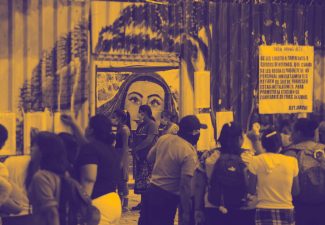
This opportunity, for the second semester of 2025, allows for the exchange of tools and research-action strategies developed at Dejusticia, as well as the contributions of interns and fellows with their own experiences and those of their organizations.
Read MoreClimate justice requires a development agenda from the South
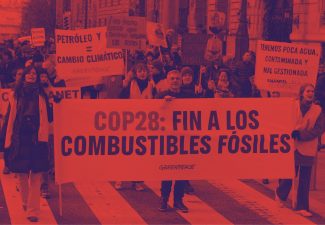
COP 28 revealed the tensions between climate ambitions and actual actions. How to implement development and cooperation strategies in line with climate justice in the Global South?
Read MoreA story of uncertainty and access to information: the search for missing persons in Latin America
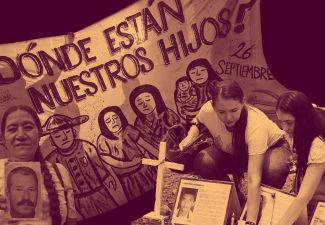
Although the contexts in Mexico and Colombia are different, both cases highlight the importance of accessing judicial and extrajudicial information as a necessary prerequisite for the success of searches and the relief of family members.
Read More3 challenges to the human rights agenda in 2024: a Global South perspective
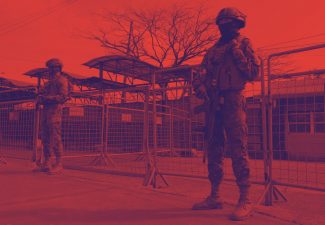
We present El Sur Global, an international newsletter to discuss international situations and trends from a human rights perspective.
Read MoreThe challenges of Colombia’s foreign policy towards Venezuela
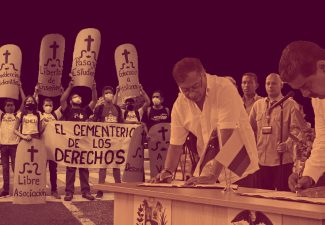
The relationship between these two countries affects regional stability. Less migration, conflict, and injustice will generate greater peace and democratic and economic growth for Latin America.
Read MoreVenezuela in a spiral
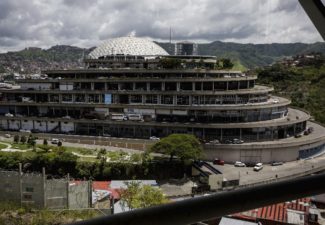
El Helicoide gets its name from the geometric shape of the building that houses the prison, which resembles a spiral. The crisis in the prison and the elections this Sunday could worsen the spiral of Maduro’s regime towards arbitrariness.
Read MoreBusinesses, democracy, and human rights

In Colombia, two strident sides tend to predominate: the private sector actors who refuse to talk about the issue and the critics who are suspicious of any business activity.
Read MoreHow I gave a mother a cake because I couldn’t get her son out of jail
Certainly one does not need to be a human rights activist to be able to shake someone’s hand. But it’s only a truly caring and grounded advocate who can write a set of policy recommendations and at the same time keep giving hope to the people s/he works with to make sure that all this does not become pointless in the end.
Read MoreWill Candelaria go to school? Barriers to access education for Venezuelan migrant children

Although there are no exact figures on the magnitude of the Venezuelan exodus and much less on its demographic characteristics, studies estimate that during this year, about 15% of the population will have left the country. How is Colombia securing the rights to education of the boys and girls who have arrived?
Read MoreHuman Rights and the Practical Power of Art

At a time when the human rights movement is facing great challenges, and at a moment when there is a widespread recognition that the human rights movement must be more interdisciplinary, and locally connected, human rights advocates should be more purposeful in integrating art, in addition to social sciences, into our practice.
Read MoreThe world is still wide and alien
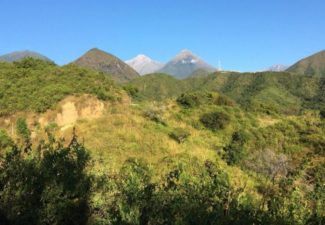
The unforeseen incidents of bringing together a handful of indigenous leaders from around the world to Colombia for the First Global Workshop for Indigenous Leaders.
Read MorePoverty, inequality and discrimination in Latin America
When governments are seeking to reduce poverty based on discrimination and increase rights protection, policies must also aim to reduce discrimination due to historical factors. The latter has created the very own elements that facilitate the impoverishment of various social groups.
Read MoreRecipes against climate change

The solutions to combat climate change are closer than you think. There are small, everyday actions that citizens can contribute to, starting from something as simple as being more aware of what we serve on our plates.
Read MoreColombia Peace Agreement: participation and protest
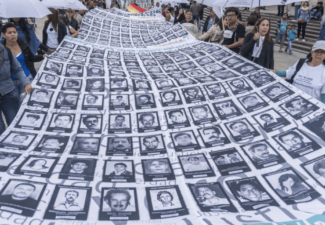
The 2016 Peace Agreement between the Colombian government and FARC includes explicit aims to improve democratic participation and protect the right to protest. But how are these goals being threatened?
Read MoreHuman rights, climate change and displacement: Where do we even begin?
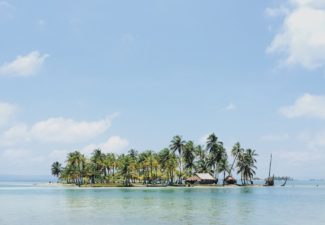
As climate-induced displacement forces more and more people to move, the international community grapples with the challenge of how to define, categorize, and respond to the phenomenon. While the loss of place is irreplaceable, we can certainly implement a human rights approach to move forward in a way that does justice to the needs of those directly affected.
Read MoreFighting the tide: Human Rights and Environmental Justice in the Global South
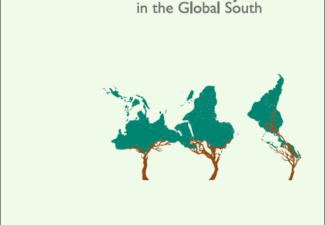
This text forms part of a long-term project undertaken by Dejusticia as part of its international work. The project revolves around the Global Action-Research Workshop for Young Human Rights Advocates that Dejusticia organizes each year to foster connections among and train a new generation of action researchers.
Read MoreAssessment of Existing National Action Plans (NAPs) on Business and Human Rights (2017)
The International Corporate Accountability Roundtable (ICAR), the European Coalition for Corporate Justice (ECCJ), and the Center for the Study of Law, Justice, and Society (Dejusticia) are pleased to release an updated report on Assessments of Existing National Action Plans (NAPs) on Business and Human Rights (August 2017).
Read MoreJustice Mosaics: How Context Shapes Transitional Justice in Fractured Societies
Two of our researchers contribute a chapter to a book by the International Center for Transitional Justice.
Read MorePeace, everyone’s business! Corporate accountability in transitional justice: lessons for Colombia
The report includes a comparative study of eight countries (Argentina, Brazil, South Africa, Guatemala, East Timor, Sierra Leone and Liberia) that used transitional justice to judge crimes by corporate actors during armed conflicts.
Read MoreReimagining Human Rights
Our Director, César Rodríguez, published the article “Reimagining Human Rights” in the Journal of International Law and International Affairs.
Read MoreSocial Rights Judgments and the Politics of Compliance: Making it Stick (Cambridge University Press)
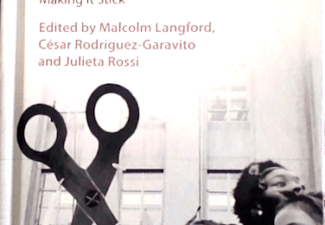
The book “Social Rights Judgments and the Politics of Compliance”, edited by César Rodríguez Garavito, director of Dejusticia, Malcolm Langford (Univ. Oslo) and Julieta Rossi (Univ. Lanús) was just published.
Read MoreDemocracy, Justice & Society: Ten Years of Research at Dejusticia
This book collects the essential from the texts on justice elaborated during the last decade in the Center for the Study of Law, Justice and Society – Dejusticia.
Read MoreExtractivism versus human rights: chronicles of the mined fields in the Global South

Un nuevo acercamiento a los derechos humanos: escritura reflexiva por autores activistas de organizaciones defensoras que considera el potencial, los logros y desafíos de su práctica.
Read MoreArguments and pathways for the ratification of the American Convention on Protecting the Human Rights of Older Persons
On June 15, 2015, the General Assembly of the Organization of American States (OAS) adopted the text of the Inter-American Convention on Protecting the Human Rights of Older Persons (Convention on Older Persons).
Read MoreEffective Criminal Defense in Latin America

This book analyzes the national and regional standards related to effective criminal defense. It is the result of a joint research project conducted with different organizations including Dejusticia.
Read MoreExpert Opinion about Administrative Reparations before the Inter-American Human Rights Court
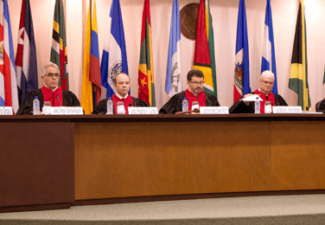
Camilo Sánchez, transitional justice research coordinator, presented an expert opinion about the administrative reparations program and the compliance of the Land Restitution and Victims’ Law to international standards before the Inter-American Court of Human Rights, within the framework of the case “Yarce and others v. Colombia.”
Read MorePress Release – International human rights network intervenes in case challenging large-scale disconnection of water supply to tens of thousands of low-income residents in Detroit
New York. February 9, 2015. The International Network for Economic, Social and Cultural Rights (ESCR-Net), a global network of over 220 groups and 50 individual advocates from around the world working to secure economic and social justice through human rights, has requested leave from the U.S. District Court to be recognized as amicus curiae[1] in the case of Lyda et al. v. City of Detroit[2]in support of residents challenging the City of Detroit’s decision to cut off water supply to thousands of households unable to pay their bills.
Read MoreAmicus Curiae for Mr. President of the Transitory Liquidating Criminal Court
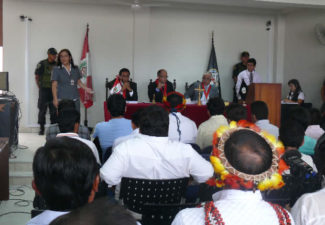
Presented by the Due Process of Law Foundation, Human Rights Center of the Pontifical Catholic University of Ecuador, the Center for the Study of Law, Justice, and Society- Dejusticia.
Read MoreTutela UP – Díaz Mansilla Family
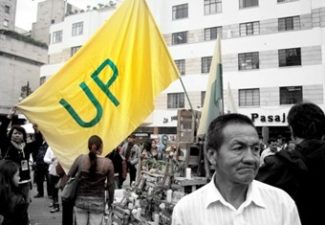
30 years ago Miguel Ángel Díaz was forcefully disappeared in Puerto Boyacá with participation of a DAS agent. He was one of the first victims of the persecution against the Patriotic Union.
Read MoreIntervention in the Case of Belo Monte
The Inter-American Association for Environmental Defense (AIDA), the Center for the Study of Law, Justice and Society (DEJUSTICIA), the Socio-Environmental Institute (ISA), The Yudjá Mïratu da Volta Grande do Xingu Indigenous Association (AYMÏX) and the Indigenous Missionary Council (CIMI) presented before the Supreme Federal Court of Brazil written memo that shows the illegality of the Congressional permit for the Belo Monte dam.
Read MoreIntervention: Defense of the Superintendent of Health´s Letter 03/13 on Voluntary Interruption of Pregnancy
Dejusticia intervened before the State Council to support the legality of the Superintendent of Health’s Letter 03 from 2013 on voluntary interruption of pregnancy.
Read MoreAmicus about the Rights of Indigenous Populations
Dejusticia, the Global Justice and Human RightsProgram at Universidad de los Andes, and the Law School Clinics at the Pontificia Universidad Católica de Perú and Stanford presented an amicus curiae challenging the constitutionality of guidelines regulating the Official Data Base of Indigenous and Native Peoples in Peru.
Read MoreLetter regarding human rights and drug policies to governments participating in the OAS General Assembly in Guatemala.
More than fifty civil society organizations from the Americas presented a letter to the governments gathered this week in Guatemala, for the General Assembly meeting of the OAS. In the letter the organizations urgently call for putting human rights protection at the center of the debate over drug policies.
Read MoreIntervention before the IACtHR regarding Costa Rica’s prohibition of invitro fertilization
Dejusticia presented an amicus before the Inter-American Court of Human Rights regarding Costa Rica’s prohibition of in vitro fertilization.
Read MoreAmicus Curiae on the official duty to investigate sexual crimes and proof standards in sexual violence
Dejusticia submitted an amicus in a motion for legal protection case filed by a women’s organization against the Attorney General’s Office, claiming the infringement of the rights of access to justice and due process of a girl allegedly abused by her father.
Read More