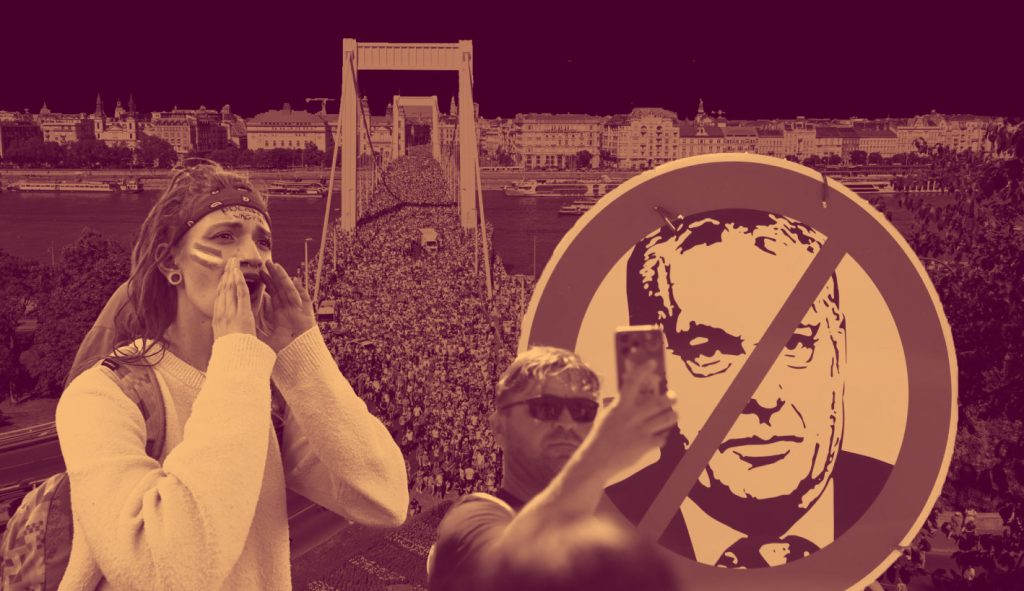
Despite the pressure, civil society in Hungary has adapted. | EFE
The Hungarian Case and its Anti-NGO Laws
Por: Nina Chaparro González, Oliver Hodges-Jackson | October 2, 2025
If you drop a frog into boiling water, it will jump out immediately. But if you slowly increase the temperature, it will stay until its too late. That’s how civic space disappears: not with a sudden crackdown, but through a gradual development of legal pressure that erodes civic activity, until there is no room left.
Orbáns Authoritarian shift
Since returning to power in 2010, Viktor Orbán has systematically dismantled Hungary’s democratic institutions. Backed by a constitutional supermajority his party – Fidesz – has amended the Constitution fifteen times, and overhauled the country’s legal order. Media outlets have been brought under state influence, education has been politicised, and the judiciary co-opted.
One of the most sustained targets is civic space. Orbán’s government has invoked transparency and national sovereignty to justify a series of laws designed to suffocate independent civil society.
LexNGO and the Beginning of Legal Repression
In 2017, Hungary passed the Law on the Transparency of Organisations Receiving Foreign Funds – LexNGO 2017 – marking the first of series of laws used to label independent groups as foreign agents. It required organisations receiving over HUF 7.2 million annually (around 24,000 euros) from abroad, to register and publicly label themselves as “foreign funded”, disclosing donors.
The law disproportionately affected CSOs critical of the state and triggered infringement proceedings from the European Commission. In 2020, the Court of Justice of the European Union (CJEU) ruled that LexNGO 2017 breached European Union (EU) law on two grounds. It violated the free movement of capital under Article 63 TFEU by deterring cross-boarder donations, and it infringed upon the rights of freedom of association and private life, by imposing undue interference on the operation of independent organisations. The court recognised transparency as a legitimate justification but found Hungary’s measures neither necessary nor proportionate. The CJEU called for the laws repeal.
Hungary repealed the law after a year’s delay but replaced it with LexNGO 2021. LexNGO 2021 empowers the State Audit Office to inspect NGOs with annual budgets exceeding HUF 20 million (around 53000 euros). Despite being rebranded, it is operationally similar to its predecessor, drawing similar criticism for discriminatory application and potential breaches of EU law. LexNGO 2021 remains in force despite ongoing constitutional complaints.
The same tactic followed the Stop Soros legislation, which criminalised assistance to asylum seekers. The CJEU found it incompatible with EU law, but Hungary made only minor changes and left the core provisions in place.
In both cases, the Hungarian government has delayed, rebranded, or diluted the laws – but never fully complied with the CJEU, undermining the authority of the European legal order.
Escalation: ‘Operation Starve and Strangle’
In 2023, the government went further. The Act on the Protection of National Sovereignty established an investigative body with sweeping powers and criminalised the use of foreign funds for political purposes.
Then, earlier this year, Fidesz proposed the new Act on Transparency and Public Life, widely seen as the most aggressive attack on independent civil society yet. At the heart of the proposal is a discretionary power granted to the Sovereignty Protection Office (SPO) to list any organisation as “under foreign influence”. If an organisation is listed:
- It will be prohibited from receiving foreign funding, unless approved by the Tax Office in an unregulated and unknown procedure.
- It becomes ineligible for 1% tax donations from Hungarian citizens.
- Donors must provide the origin of their contributions.
- Noncompliance may result in severe fines or forced dissolution.
Although the bill applies to any legal entity, government officials and SPO materials have made it clear the targets include watchdogs, journalists, independent media, and CSOs.
Although the vote has been delayed, the bill remains active, and the threat is real.
The Chilling Effect
Although these laws seldom trigger legal action, their power lies in their chilling effect. The threat of being listed, audited, or stigmatised discourages cooperation and activity. Schools shy away from engaging with stigmatised NGOs. Services are rejected out of fear of retaliation from the administration. And state resources now flow to government-organised NGOs (GONGOs) as independent voices are starved.
If enacted, the proposed Act on Transparency and Public Life would have far more severe consequences. Opaque procedures that offer no meaningful legal remedy could allow authorities to block listed organisation from receiving foreign funding and accessing domestic revenue. The bill would strangle their operational ability and could lead to bans or forced dissolution.
Strategies of Resilience
Despite the pressure, civil society in Hungary has adapted.
While international legal victories for civil society have been important, the broader system of European enforcement has failed to be an effective deterrent. Equally, domestic litigation has offered minimal recourse as Lack of judicial independence prevents structural change, as displayed in the Amnesty case against the Stop Soros law.
Under an administration with unchecked domestic power, legal ingenuity, and an incentive to restrict the civic space, litigation must be one element of a wider defence strategy.
Stefánia Kapronczay, former co-director of the Hungarian Civil Liberties Union (HCLU), explained in our interview, their organisational response. The HCLU boycotted LexNGO 2017, publicly challenging unconstitutional legislation they found “so blatantly unlawful for violating human rights”. When smear campaigns followed, they used the publicity to reaffirm their core values, turning attacks into opportunities for strategic messaging.
Funding diversification also became a strategic priority – not just to reduce dependence on foreign funding, but to strengthen legitimacy through the support of Hungarian citizens whom the HCLU defends. To build public trust, the HCLU exceeded government transparency regulations, and published comprehensible financial graphs.
“There is no better argument than pointing to the 6000 Hungarians who support us with their money” Stefánia Kapronczay explained, when responding to claims that the HCLU does not stand for Hungarian interests.
Coalition as Defence
Equally important to preserving financial independence is establishing unity.
In an environment designed to isolate and divide, Stefánia explained that while “It’s human nature to turn inwards… it’s a trap”. Responding with unity is critical as the crackdown can create openings for unexpected alliances. The external pressure can align youth, environmental, community, and human rights organisations – around common aims.
For example, Civiliźació, a coalition of 30 core organisations, and over 300 affiliates, now plays a key role in coordinating responses and defending space for independent civic action.
A Moment of Resistance
These strategies were essential when combatting ‘Operation Starve and Strangle’.
Over 325 organisations submitted an open letter to the EU and the Council of Europe’s Commissioner for Human Rights urged Hungarian lawmakers to reject the bill. Citizens mobilised to protest the bill in silence with their mouths taped shut to symbolise the silencing of civil society.
The delay marked a considerable success for civil society, but the risk of escalation still remains.
Hungary as a Warning
Hungary’s case serves as a warning.
The closure of civic space is not limited to authoritarian contexts. It is a global trend that is appearing in once-consolidated democracies.
Like the frog in boiling water, civic space does not collapse overnight. It shrinks slowly through legal changes, financial pressure, and political stigmatisation, until the threat is existential.
Civil society must recognise the early warning sings: rhetoric of transparency and national sovereignty, legal ambiguity, rising administrative demands, and restrictions on funding. These should trigger action – coalition building, funding diversification, and contingency planning.
Civic space is not guaranteed in any state, and the best defence is preparation.
Blog wrote by Oliver Hodges-Jackson, Global North Fellow and Kings College London Undergraduate, and Nina Chaparro, Enlaza Strengthening Coordinator Program.