


Area-Global South & North Collaborations (Internationalization)
Guatemala: Dejusticia intervenes in a process that seeks to protect the right to prior consultation of the Xinka people
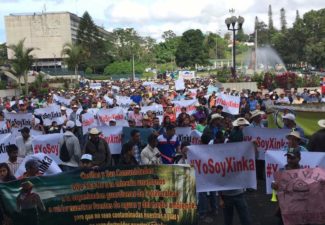
During 2012 and 2013, the Ministry of Energy and Mines granted licenses for the exploitation of the Escobal mining company without consulting indigenous people. Eight international organizations presented an amicus to support the communities.
Read MoreThe foreign minister’s silence on Colombians imprisoned in Venezuela

More than 60 innocent Colombians sleep in Venezuelan jail cells. Although similar situations have resulted in diplomatic confrontations between Venezuela and countries such as Brazil, in Colombia, the Minister of Foreign Affairs, María Ángela Holguín has kept a low profile.
Read MoreVenezuela Must Respect the People’s Right to Free and Fair Elections
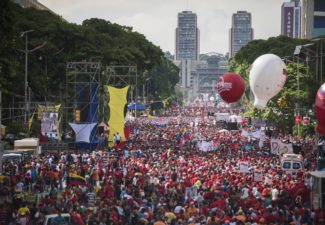
On January 23, Venezuela’s National Constituent Assembly (ANC) approved a decree that calls for presidential elections to be held by April 30, 2018. As organizations devoted to advancing human rights in the Americas, we are profoundly concerned
Read MoreMaduro’s persecuted

The flight to Europe by the former mayor of Caracas, Antonio Ledezma, uncovers one more of the 342 stories of political prisoners fleeing the government of Nicolás Maduro.
Read More#VenezuelaBienvenida: Colombian-Venezuelans return to Colombia, a product of the crisis

For decades millions of Colombians crossed the border into Venezuela, fleeing our armed conflict. Now the humanitarian crisis created by the Maduro government is bringing back the children of those migrants. #VenezuelaWelcome is a call to solidarity.
Read More“Today, even Chavistas are persecuted in Venezuela”: Rafael Uzcátegui
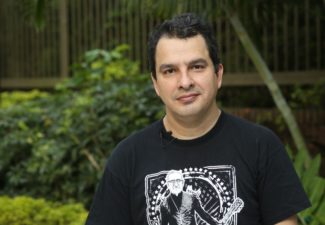
The director of the Venezuelan NGO, Provea, visiting Colombia on invitation from Dejustica, speaks about the escape of prosecutor Luisa Ortega and the possibility of a new wave of protests in principal cities around the country.
Read MoreThe dark side of conservation

The conservation of nature and biodiversity is a legitimate goal, but what are the costs and power dynamics behind the traditional idea of “conservation”? Who is it benefiting and who is carrying the costs?
Read MoreOsamah, the Yemeni activist who has not seen reconciliation

El Colombiano, a newspaper in Medellín, interviewed Osama Al Fakih, a human rights defender from Yemen, who was part of our 5th Global Workshop. The event, held in August in Cali and Bogotá, brought 15 activists from around the world who debated the need to reopen civil society spaces to defend human rights.
Read MoreMurat Çelikkan: When dissent becomes crime
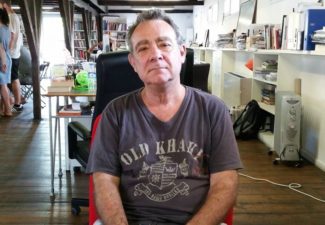
This weekend he was supposed to come to Colombia, to a forum on human rights in Cali. Today the Turkish activist is in jail for being editor of an opposition newspaper.
Read MoreDejusticia, ICAR and ECCJ release updated report on Assessments of Existing National Action Planson Business and HR

The International Corporate Accountability Roundtable (ICAR), the European Coalition for Corporate Justice (ECCJ), and the Center for the Study of Law, Justice, and Society (Dejusticia) are pleased to release an updated report on Assessments of Existing National Action Plans (NAPs) on Business and Human Rights.
Read More21st century socialism, dictatorship or rebellion?
The Venezuelan government is advancing in its plan to dismantle the 1999 Bolivarian Constitution. And it is the 21st century rebels who defend democracy and human rights against the heirs of 21st century socialism who abdicated their democratic promise.
Read MoreFrantz and war
Frantz, a film by the French director François Ozon, deals with the absurdity of war and the terrible fate of societies entangled in it.
Read MoreAccess to ICTs: Is it just about giving power to the people?

Citizens’ enfranchisement is not the only empowerment that will come alongside universalized access to information technology. Indeed, total connectivity will also empower data collectors. But as the digital divide has not yet been closed, there is still time to look for tools to cope with the informatics power that governments and Internet platforms will be able to acquire.
Read MoreHumboldt vs. Trump
In times of egos enlarged by social media, such as Trump’s, we lack the cosmic vision of Humboldt, where everything is interconnected.
Read MoreThe Alien Tort Statute’s Stakes for Property
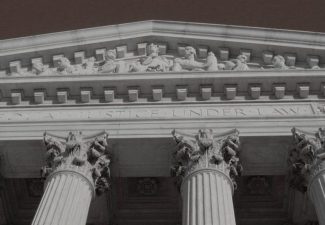
The United States Supreme Court’s decision in Jesner v. Arab Bank, PLC will determine whether or not the ATS may be used in cases against corporations, carrying implications for actors working on corporate liability issues across the globe.
Read MoreGlobal tensions and local leadership
In the current global context, hopelessness can only be overcome through local leadership, which through concrete actions on a daily basis restores community ties and prevents the promotion of polarization.
Read MoreGlobal Conversations

In times of an upside down world , achieving global conversations is an urgent challenge. This is suddently a new opportunity to build a global united front for a new world in which other forms of life are included.
Read MoreThe Shrinking of Civic Spaces: What is Happening and What Can We Do?

In addition to the threat of populism, human rights face another distinct, yet related phenomenon: the shrinking of civil society spaces around the world.
Read MoreMadurazo
There were no tanks attacking the civil institutions, which characterized previous coups. But in Venezuela there was a coup d’état, which intends to be judicially legalized, but that nevertheless is a democratic rupture.
Read MoreClarification on Cajarmarca
Despite the interests and passions at stake, we must accept and debate with arguments the decision of the inhabitants of Cajamarca to ban mining and protect the water and agricultural interests of their municipality.
Read MoreExperiences in Latin American Countries on the Investigation of Complex Crimes
In this document we describe some of the experiences in the region’s countries regarding the investigation of complex crimes.
Read MoreAccess to Justice: Cases of Business Human Rights Abuses
Access to justice and effective remedy have become a crucial element in the protection of human rights within the context of business activities, as well as an area of fundamental importance to judges and lawyers who aim to promote the rule of law and human rights.
Read MorePractical Guide of the International System of Protection of Human Rights

The guide is an effort to improve the quality and availability of the information regarding the systems in place to protect human rights. It serves as a reference for individuals interested in the relation of justice, conflict, law and order to human rights.
Read MoreThe Search for Alternative Economies in Times of Globalization: the Case Study of Informal Recycling in Bogotá

This text examines the potential of supportive economy in the context of globalization, by the way of a case study on the informal recycling cooperatives in Bogotá.
Read MoreExpanding the Economic Canon and Searching for Alternatives to Neoliberal Globalization

This introductory chapter theorizes and documents the diverse initiatives of supportive economy and working transnational mobilization that promises of counterhegemonic globalization.
Read MoreLaw and Globalization from Below
This book is an unprecedented effort of analyzing the role of rights within the global social justice movement, combining empirical investigation and innovative socio-legal theories on a variety of themes, from indigenous rights to the World Social Forum and global labor rights campaigns.
Read MoreRights and Society in Latin America
In this book, a group of prominent lawyers and social scientists from diverse Latin American countries strike up a dialogue and offer innovative and rigorous answers on these and other questions.
Read MoreComparative Jurisprudence: Reception and Misreading of Transnational Legal Theory in Latin America
One could say that comparative jurisprudence is any kind of work in which international general jurisprudence is broken into pieces to articulate a national, regional, tribal or otherwise group-base experience with rather abstract ideas. This strategy, then, would lead to the juxtaposition of a national, regional or group adjective and the very word “jurisprudence”.
Read More