


Issue-Transitional Justice
Thank you, Sergio Jaramillo
Whoever becomes the High Commissioner for Peace, will have to continue with a legacy that, above political and sectoral interests, prioritizes safeguarding the essence of what was agreed.
Read MoreA retroactive Special Jurisdiction for Peace
The criticism to the Special Jurisdiction for Peace (JEP) of being unacceptable for violating the prohibition of criminal retroactivity is actually confusing two related, but distinct things: retroactivity of laws that create crimes or aggravate penalties, which is not admissible in a democracy; and retroactivity of criminal courts, which is appropriate in certain circumstances.
Read MoreFive warning signs so that the rural reform is not a failure
One of the axes of the Integral Rural Reform began to unfold: the construction of the Development Programs with a Territorial Approach (PDET), which seek to accelerate the structural transformation of the countryside in order to improve the quality of life, reverse the effects of the conflict, and contribute to the reparation and reconciliation in the territories.
Read MoreAn inclusive Special Jurisdiction for Peace
It is unacceptable to undermine the legitimacy of the Special Jurisdiction for Peace, generating unjustified doubts about an alleged ideological bias of the Election Committee and the ongoing selection process.
Read MoreThe anti-corrosive of peace
The lack of an effective and legitimate State, which earns the obedience of the people, has led Colombia to a vicious cycle of violence-peace-violence since the nineteenth century, with 26 amnesty processes and 63 pardons in total.
Read MoreThe assets of the FARC: a litmus test for the ‘fast-track’

Opposition groups that disagree with the peace process pledged to “lash out” in the new legislature against Santos-issued fast-track decrees. The next debate will center around the inventory of FARC assets.
Read MoreDear Congress members, too much noise around the Special Jurisdiction for Peace!
The proposals asking to remove the application of the Special Jurisdiction for Peace to military and civilians ignore the complex dynamics of the armed conflict.
Read MoreHow is the implementation of the Agreement on Victims going?
Despite the setbacks, the Transitional Justice System is already working. However, the sustainability of the process will depend on the decisions of the Constitutional Court and the proper processing of amnesties.
Read MoreFor a stable peace, a sensible opposition
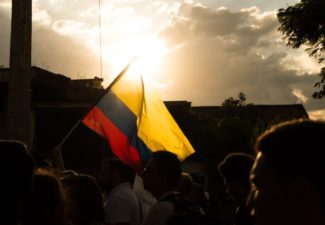
One of the most difficult wounds to heal from the armed conflict is closely related to the democratic debate. In the post-conflict period, democracies tend to be at their weakest point. Hence why a sensible dialogue between political forces is a condition for the prosperity of peace.
Read MoreThe Salamanca frog
Instead of contemplating the greatness of disarmament, which opens the door to peace, many critics have stubbornly sought out the “frog” and say that the process was all a farce. Even if it received UN verification.
Read MoreJoint communiqué on the implementation of the Peace Agreement in the territories with coca and marijuana crops in Colombia
Dejusticia, the Transnational Institute of the Netherlands, WOLA and OCDI-Indepaz sign joint communiqué on anti-drug policy in the implementation of the peace agreement.
Read MorePress Release on the Draft Legislative Act of the Integral System of Truth, Justice, Reparation and Non-Repetition
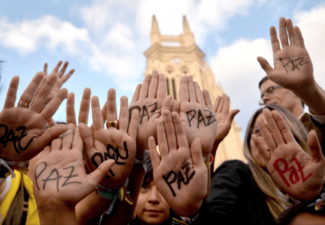
Academics and organizations, including Dejusticia, sign a communiqué to present analysis on the political convention and constitutional justification of the Draft Legislative Act 02 of 2016 Chamber, accumulated with the Draft Legislative Act 03 of 2016, which among other things creates the Comprehensive System of Truth, Justice, Reparation and Non-Repetition, in what includes the JEP and regulates the special criminal treatment for state agents.
Why certain parts of the peace accord should have legal force? Comments on the Senate’s draft bill 01 of 2016
The following text presents some reflections to the public and the national Congress related to the constitutional reform project that seeks to give stability and judicial security to the peace accord signed between the Colombia government and the FARC on November 24th, 2016.
Read MoreBojayá indigenous people claim their right to vote

Almost 70% of people from Bojayá did not vote on the peace plebiscite. A part of this group was composed by indigenous communities who claim that they were not able to reach the ballot box.
Read MoreColombia, Year Zero
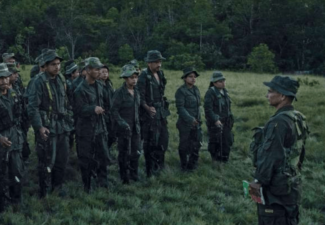
The Italian newspaper conducted a report on the Colombian peace process. For our director César Rodríguez, this accord “promotes conditions for a more inclusive society from a social, economic, and political point of view.”
Read MoreRodrigo Uprimny’s presentation in Senate hearing: endorsement and fast-track

Rodrigo Umprimny’s participation in Senate hearing on November 29, 2016.
Read MoreSeminar: 5 years after the Law of Victims and Restitution of Collective Territories – Impact On Indigenous and Afro-Descendent Communities
5 years after the Victims’ and Collective Territories Restitution Law was passed a seminar evaluates its impact on indigenous and Afro-Descendent communities in Colombia.
Read MorePress Release for the General Public and the Dialogue Table in La Habana
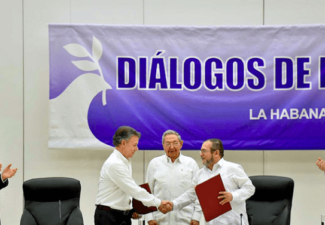
The signatory organizations address this statement to the general public and the Dialogue Table in La Habana, in order to present legal and political conciliatory points on certain issues of the Peace Agreement signed by the Colombian Government and the FARC EP on September 26th, 2016.
Map of proposals of the NO spokespeople
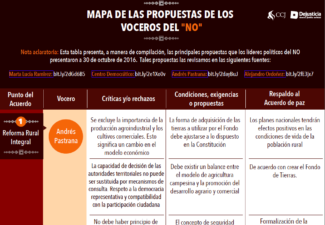
This table, elaborated by Dejusticia and the Colombian Commission of Jurists, compiles the main proposals of the political leaders of the NO.
Read MoreDejusticia intervenes at UN on transnational corporations and human rights
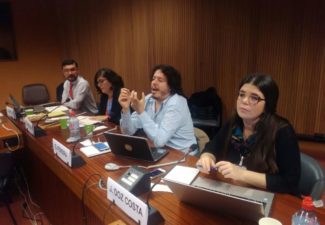
This week (October 24-28), the 2nd Session of Open-ended Intergovernmental Working Group on Transnational Corporations and Human Rights is meeting and discussing a binding legal instrument.
Read More