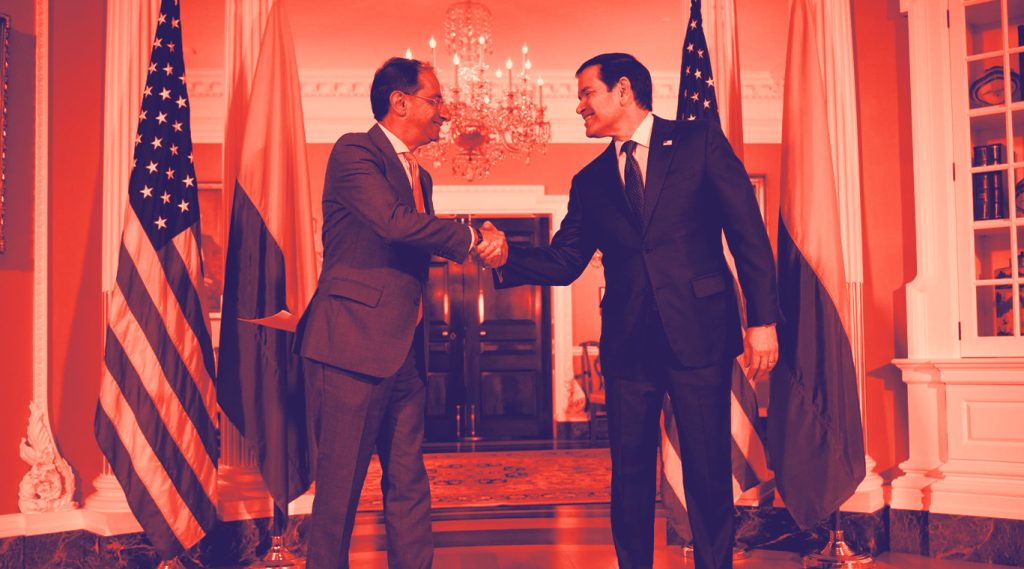
“The most extreme candidates—those with inflammatory rhetoric—won.” | EFE
Colombia’s Foreign Policy After Its Change of Course
Por: Christy Crouse | September 3, 2026
June 25, 2026 in Colombia felt very similar to November 8, 2016 in the United States. On both of those dates, the results of presidential elections were announced in which candidates with no prior political experience—but with deep ties to traditional politicians—won. The winners were the most extreme candidate: those with inflammatory rhetoric who promised security and stability for the country.
When Donald Trump first won the election in the United States, it was quite difficult to imagine how his administration would function or to gauge the impact it would have on foreign policy. Today, despite the uncertainty that the new government in Colombia may generate, we have more information to analyze what its main priorities might be in terms of foreign policy and relations with other Latin American countries. These factors relate to the positions taken by other governments in the region that have adopted platforms similar to those of Abelardo de la Espriella (ADLE). His election is part of a wave of victories for right-wing or far-right populist candidates who have championed an agenda of reducing the size of the state and weakening multilateralism, among other issues.
In this issue’s article, “Colombia Changes Course: How Might the New Government Redefine Colombian Foreign Policy and the Political Balance in Latin America?”, we explore what we can anticipate at the regional level following ADLE’s election. Who will represent Colombia on the international stage? How will Colombia position itself in international forums? How will this new political project influence the region’s political dynamics?
Through this analysis, we seek to understand the regional implications of the change in Colombia’s government in order to anticipate the potential opportunities and concerns related primarily to human rights and democracy. Although the situations in the United States in 2016 and in Colombia in 2026 are very different, in both cases it was—and remains—essential to remain vigilant and ready to respond to the challenges they pose to human rights.
At the same time, the article offers a reflection on democratic resilience: beyond the political orientation of governments, the real challenge lies in the capacity of institutions to ensure that transitions in power, and the subsequent implementation of the government’s agenda, take place within the rule of law and with full respect for democratic principles.