


The fight for racial justice through data and litigation

ILEX Acción Jurídica is an organization led by Afro-Colombian women lawyers working to realize the rights of black and Afro-Colombian populations in the country.
Read MorePowerful Baruleras

The resistance struggles of the people of Barú are now joined by the leadership of a group of women who are organizing to talk about sex education. Their activism contributed to the reduction of teenage pregnancy from 18 to 4 cases between 2018 and 2019.
Read MoreAnzorc: more than 20 years fighting for peasant dignity

In the complex process of creating and consolidating peasant reserve areas, the National Association of Peasant Reserve Areas (Anzorc) has played a key role. Here is a brief overview of its history. A history of tenacity and courage.
Read More“I lost my only son, but I gained many more”: Alba Lucía Reyes

The suicide of her only son, Sergio Urrego, as a result of bullying he experienced from the administrators of the school where he studied, led Alba Lucía Reyes to create the Sergio Urrego Foundation in 2015, focused on the prevention of suicide among children and young people and on non-discrimination in schools, a fact that made her a recognized “activist mom” for the rights of children and young people.
Read More“May the forest survive, and so may we”: the gamble taken by farmers in Caquetá

The farmers of the Caquetá foothills dream of turning their territory into the second largest Peasant Reserve Zone in the country. This would help them protect their mountains from extractivism and obtain the land that has been denied them.
Read MoreAsdown: The freedom to choose a fulfilling life with a disability

According to DANE, there are more than 1.4 million people with intellectual disabilities in Colombia. This group faces the odyssey of fighting against prejudice and myths. However, a hopeful vision leads many families to choose an inclusive society.
Read MoreEquality in freedom: Free Women for a fairer criminal policy

Prisons are a reflection of society, and in a sexist society where women face structural inequalities, they suffer even more from the impacts of the prison crisis. But women are resisting, and through the work of organizations such as Mujeres Libres, there is hope that their rights will become a reality.
Read MoreApply to our 2023 call for fellowships

The fellowship program is an opportunity for mutual exchange, both so that they can learn about the tools and action-research strategies that we develop in Dejusticia, and so that Dejusticia can learn from their experience and that of their organizations.
Read MoreMore than 400 international organizations reject the bill that seeks to stifle Venezuelan NGOs

We request that the bill be dismissed, including its reform or any other regulation that is similar in nature.
Read MoreWhat is happening in Peru? The question of difficult answers

Two months after the self-coup and subsequent dismissal of Pedro Castillo, we take stock of what has happened and what are the possible solutions to the critical moment this country is going through.
Read MoreThe sexist cartel of the robe
To break the silence of sexual violence it is necessary to “begin by believing” the victims. Also by applying international standards such as the Rome Statute against gender violence, which make it clear that silence or lack of resistance do not imply consent to abuse.
Read MoreSexual violence in the Special Jurisdiction for Peace: more penalties do not mean more truth
More important than the symbolic message that Congress intended to give by increasing the penalties for sexual violence against children is that truth and justice do in fact exist.
Read MoreWhy talk about rural Cartagena?
91.1% of Cartagena is rural: according to the SISBEN, approximately 70,000 of those who live in the 551 square kilometers face a situation of vulnerability. There, extreme poverty is four times what it is in urban areas.
Read MoreWhat happens with rural reform in Montes de María?
The delays in the construction of Development Programs with a Territorial Approach are shortening the time to guarantee spaces for the effective participation of communities and can endanger this citizen exercise if it overlaps with electoral campaigns.
Read MoreThe reduction of penalties for small growers is necessary
The Ministry of Justice’s proposal, a bill that regulates the differential criminal treatment for small coca, marihuana and poppy growers, proposes a permanent reduction of penalties for the cultivation and conservation offenses. This reform is an urgent and necessary step towards drug reform policy.
Read MoreHuman rights, climate change and displacement: Where do we even begin?

As climate-induced displacement forces more and more people to move, the international community grapples with the challenge of how to define, categorize, and respond to the phenomenon. While the loss of place is irreplaceable, we can certainly implement a human rights approach to move forward in a way that does justice to the needs of those directly affected.
Read MoreBittersweet sentence
The ruling of the Constitutional Court on the Special Jurisdiction for Peace has ambiguous effects: it could give a stronger floor to the JEP and peace, but for now everyone seems dissatisfied.
Read MoreThe invisible city
Citizen culture, which is a very important part of what a city is, is an invisible form of capital that cannot be sold on the stock market, but that is worth a lot.
Read MoreObese and famished
According to the latest Survey on the Nutritional Situation of Colombians, which was released this week, overweight rates in adults and children increased. This revelation opened the debate once again to imposing limits on ultra-processed food advertising and a tax on sugary drinks.
Read MoreRestricting junk food advertising: censorship or health protection?

It is time for Latin America to take on the challenge and decide whether commercial speech needs to be protected over children’s health or whether it can be restricted in order to prevent increasing children’s obesity rates. The recent decision by the Colombian Constitutional Court is a good step forward, but it is not enough.
Read MoreNo Truce: Public Policies for the Reparation for Women Victims of Sexual Violence During Dictatorships

This book is the product of a reflection process of groups that share a common past characterized by armed conflicts and military regimes responsible for massive human rights violations of their citizens.
Read MoreVictims for the Search for Truth and Reparation in Colombia
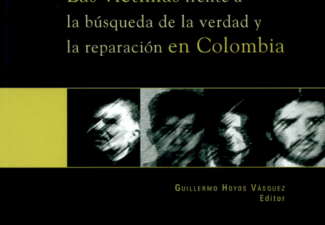
This book is a summary of diverse conferences that took place at the “Truth and Repair in Colombia: from the victims’ perspective” seminar revolved around the same issue: a search for solutions for repair and reconciliation in Colombia.
Read MoreTutelas Against Sentences

The problem that is discussed in this document is: What can we do to avoid those “train crashes” that do much harm to justice, and therefore to the whole country?
Read MoreTransitional Justice without Transition? Truth, Justice and Reparations for Colombia
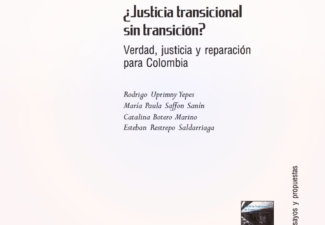
The studies contained in this book offer empirical, regulatory and conceptual tools that can help understand transitional justice in Colombia.
Read MoreConstitutional Interpretation
This book looks at the contribution of discussion, comprehension and improvement of the abilities of Colombian judges in the interpretation of the Constitution.
Read MoreThe Penal Process Between Efficiency and Justice: The Technical Application of Judicial Direction of the Process of the Penal Accusatory System
This book examines the functions of direction, control and management in the process that should exert the Colombian judge into the framework of the new accusatory penal system that has been implemented by the Legislative Act 3 of 2002 and the Law 906 of 2004.
Read MoreReflections on the New Penal Process System. The Challenges for the Colombian Penal Judges
This book compiles six studies whose central idea is that of promoting an accusatory criminal system in Colombia.
Read MoreJustice for All? The Judicial System, Social Rights and Democracy in Colombia
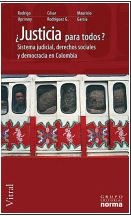
The objective of this book is to offer an explanation of the origin, content and effect of the recent judicial reforms. The authors also undertake the challenge of evaluating the policies of judicial reform that have been developing in Colombia and in Latin America over the last two decades.
Read MoreThe Laws of the Judges
The Laws of Judges, already a classic of Colombian legal literature, offers in this second edition a substantial revision of its content and structure.
Read MoreThe Constitution and Economic Model in Colombia: Towards a Productive Discussion Between Economy and the Law
Community Radios
This suit against the Ministry of Communications aruges that the Miistry should have granted a community radio one or more stations in the capital of the country.
Read More