


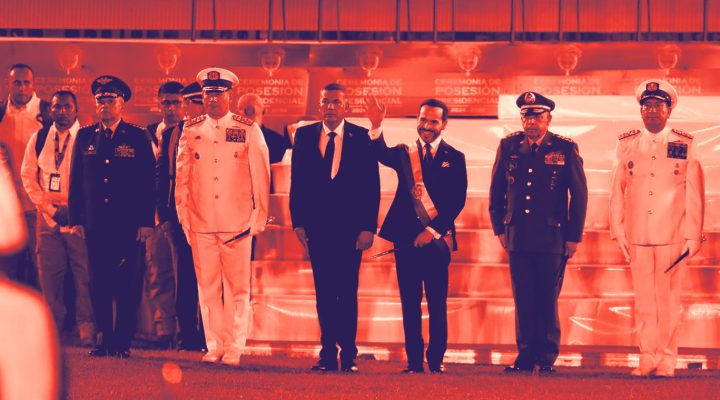
Colombia Changes Course: How Might the New Government Redefine Colombian Foreign Policy and the Political Balance in Latin America?
The transition from the Gustavo Petro administration to that of Abelardo de la Espriella marks a redefinition of Colombia’s development model. This analysis explores the diplomatic shift toward the U.S. and Israel, the move away from multilateral agendas, and the democratic implications of the reconfiguration of Latin America.
By Christy Crouse, Sofia Forero Alba | | Abelardo De La Espriella, Colombia-U.S. Relations, Colombian Foreign Policy, Latin American Geopolitics, Omar Bula Escobar, Political Transition in Colombia
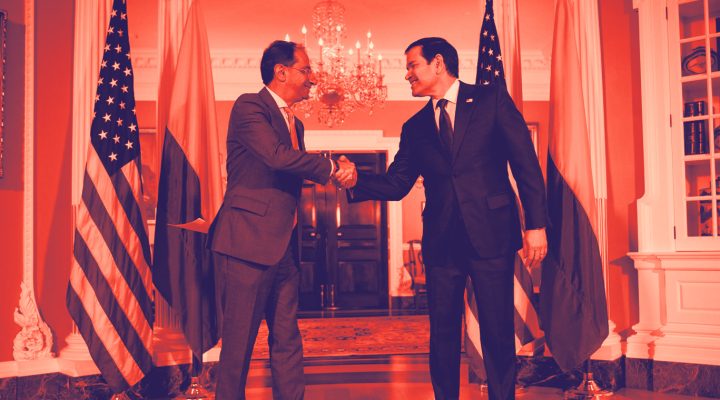
Colombia’s Foreign Policy After Its Change of Course
Abelardo de la Espriella's victory marks a change of course in Colombia. We analyze how his administration may redefine foreign policy, multilateralism, and democratic balances in Latin America in the face of human rights challenges.
By Christy Crouse | | 2026 Colombian Elections, Abelardo De La Espriella, América Latina, Colombia, Colombian Foreign Policy, Democracy and human rights, Latin American Politics, Política Exterior, Right-Wing Populism
News
Search in News
Colombia Changes Course: How Might the New Government Redefine Colombian Foreign Policy and the Political Balance in Latin America?
By Christy Crouse, Sofia Forero Alba | | Abelardo De La Espriella, Colombia-U.S. Relations, Colombian Foreign Policy, Latin American Geopolitics, Omar Bula Escobar, Political Transition in Colombia
The arrival of the new Colombian government is not merely a democratic transition. It represents a redefinition of the political project and the role Colombia seeks to play on the ...
Lea más 
Colombia’s Foreign Policy After Its Change of Course
By Christy Crouse | | 2026 Colombian Elections, Abelardo De La Espriella, América Latina, Colombia, Colombian Foreign Policy, Democracy and human rights, Latin American Politics, Política Exterior, Right-Wing Populism
June 25, 2026 in Colombia felt very similar to November 8, 2016 in the United States. On both of those dates, the results of presidential elections were announced in which ...
Lea más 
Defend the ICC: INCLO national human rights organizations call on states to protect international rule of law against United States attack
By Dejusticia | | Human Rights, ICC, International Criminal Court, International Justice, multilateralism, United States
As national human rights organizations working across every region of the globe, we are alarmed by the campaign announced by the United States Department of State to “dismantle” the International ...
Lea más 
Defending human rights around the world requires funding
By Mariana Matamoros | | CIDH, Derechos Humanos, Desigualdad, Global South, IACHR, Inequality, Justicia Fiscal, Public spending, Sustainable development., Tax cooperation, Tax justice, Tax policy
We live in a time when major global challenges—inequality, the climate crisis, and technological transformations, among others—require governments to have greater capacity to guarantee rights and promote the well-being of ...
Lea más 
Who should collect taxes when services cross borders?
By Mariana Matamoros | | Digital economy, Digital taxes, International taxation, Justicia Fiscal, Sustainable development., Tax justice, Tributación internacional, United Nations
For decades, international tax rules were designed for an economy very different from today’s. In that world, companies produced physical goods and had factories and offices in the countries where ...
Lea más 
From Taxes to Rights
By Mariana Matamoros | | CIDH, Fiscal justice, fiscal policy, Human Rights, IACHR, Justicia Fiscal, Public budget, Public investment, Social inequality., Tax policy, taxes
Let’s imagine for a moment a public school in a rural area, a hospital that treats hundreds of people every day, or a drinking water system that serves a community ...
Lea más Search in Opinion
An Independent DANE?
By Rodrigo Uprimny Yepes | | Acceso a la información, Colombia, Reforma a la justicia, Reforma a la justicia
Now that the balance of powers has been discussed so widely, is it not worth it to promote a truly independent statistical public institution? (DANE is the Colombian government's bureaucracy charged with developing statistical reports, much like the U.S. CBO)
Lea más Radicalized Environment
By César Rodríguez-Garavito (Retired in 2019) | | Medio Ambiente, Minería, Recursos naturales, Recursos naturales
We need to "deradicalize" the debate about the environment.
Lea más Did the Amazon’s lifesaver get punctured?
By Carlos Andrés Baquero Díaz, Diana Rodríguez Franco | | Medio Ambiente, Minería, Recursos naturales
The Santos adminsitration's good intentions in the Amazon have been undone by its own actions. As told by La Silla Vacía, in August 2012 ex-Minster of the Environment Frank Pearl, before leaving office, threw a lifesaver for the Amazon. Pearl released Resolution 1518 of 2012, which establishes that no one can drill any part of the Amazon classified as Forest Reserve (according to Law 2 of 1959) for mining activities, until the Ministry of the Environment zoned the territory. In other words, until it defined which areas of the Amazon territory classified as Forest Reserve-- the large majority (see Map 1)-- should be protected and which can house economic projects, among them mining.
Lea más
Stories
FromTheTerritory
We travel with 20 indigenous activists of the world to the heart of the Sierra Nevada de Santa Marta. Listen to this story about the Kankuama Resistance.
Dejusticia's
Documentaries
Discover some of the documentary pieces that we have made. Indigenous resistance, migration of Venezuelans to Colombia and stories of women coca growers, are some of our topics of interest.
