



Colombia Changes Course: How Might the New Government Redefine Colombian Foreign Policy and the Political Balance in Latin America?
The transition from the Gustavo Petro administration to that of Abelardo de la Espriella marks a redefinition of Colombia’s development model. This analysis explores the diplomatic shift toward the U.S. and Israel, the move away from multilateral agendas, and the democratic implications of the reconfiguration of Latin America.
By Christy Crouse, Sofia Forero Alba | | Abelardo De La Espriella, Colombia-U.S. Relations, Colombian Foreign Policy, Latin American Geopolitics, Omar Bula Escobar, Political Transition in Colombia
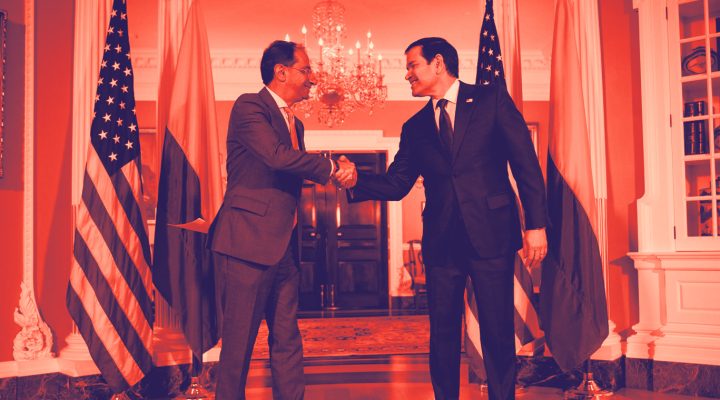
Colombia’s Foreign Policy After Its Change of Course
Abelardo de la Espriella's victory marks a change of course in Colombia. We analyze how his administration may redefine foreign policy, multilateralism, and democratic balances in Latin America in the face of human rights challenges.
By Christy Crouse | | 2026 Colombian Elections, Abelardo De La Espriella, América Latina, Colombia, Colombian Foreign Policy, Democracy and human rights, Latin American Politics, Política Exterior, Right-Wing Populism
News
Search in News
Colombia Changes Course: How Might the New Government Redefine Colombian Foreign Policy and the Political Balance in Latin America?
By Christy Crouse, Sofia Forero Alba | | Abelardo De La Espriella, Colombia-U.S. Relations, Colombian Foreign Policy, Latin American Geopolitics, Omar Bula Escobar, Political Transition in Colombia
The arrival of the new Colombian government is not merely a democratic transition. It represents a redefinition of the political project and the role Colombia seeks to play on the ...
Lea más 
Colombia’s Foreign Policy After Its Change of Course
By Christy Crouse | | 2026 Colombian Elections, Abelardo De La Espriella, América Latina, Colombia, Colombian Foreign Policy, Democracy and human rights, Latin American Politics, Política Exterior, Right-Wing Populism
June 25, 2026 in Colombia felt very similar to November 8, 2016 in the United States. On both of those dates, the results of presidential elections were announced in which ...
Lea más 
Defend the ICC: INCLO national human rights organizations call on states to protect international rule of law against United States attack
By Dejusticia | | Human Rights, ICC, International Criminal Court, International Justice, multilateralism, United States
As national human rights organizations working across every region of the globe, we are alarmed by the campaign announced by the United States Department of State to “dismantle” the International ...
Lea más 
Defending human rights around the world requires funding
By Mariana Matamoros | | CIDH, Derechos Humanos, Desigualdad, Global South, IACHR, Inequality, Justicia Fiscal, Public spending, Sustainable development., Tax cooperation, Tax justice, Tax policy
We live in a time when major global challenges—inequality, the climate crisis, and technological transformations, among others—require governments to have greater capacity to guarantee rights and promote the well-being of ...
Lea más 
Who should collect taxes when services cross borders?
By Mariana Matamoros | | Digital economy, Digital taxes, International taxation, Justicia Fiscal, Sustainable development., Tax justice, Tributación internacional, United Nations
For decades, international tax rules were designed for an economy very different from today’s. In that world, companies produced physical goods and had factories and offices in the countries where ...
Lea más 
From Taxes to Rights
By Mariana Matamoros | | CIDH, Fiscal justice, fiscal policy, Human Rights, IACHR, Justicia Fiscal, Public budget, Public investment, Social inequality., Tax policy, taxes
Let’s imagine for a moment a public school in a rural area, a hospital that treats hundreds of people every day, or a drinking water system that serves a community ...
Lea más Search in Opinion
Alberto Rojas and Ciro Angarita
By Mauricio García Villegas |
The election of Alberto Rojas as judge of the Constitutional Court made me think about December 1st of 1993. During that day took place the election, in Congress, of the first permanent judges of the Constitutional Court.
Lea más Lawsuit against the designation of the Superintendent of Vigilance and Private due to the noncompliance of the Quota Law
By Dejusticia | | Género, Género, Juan Manuel Santos, Juan Manuel Santos, Ley de cuotas, Ley de cuotas
Dejusticia, Sisma Mujer and the Red Nacional de Mujeres challenged the selection of the Superintendent of Surveillance and Private Security as a violation of the Quotas Law, arguing that the President had an obligation to appoint a woman for the post, and yet appointed a man.
Lea más Real and imaginary walks
By Mauricio García Villegas |
Lets suppose that the Inspector General Ordoñez wins next presidential elections (the gods will not allow it) and achieves it through a government plan that promises restoring moral, tradition and family. Lets suppose that, in the development of this program, Ordoñez prohibits the consumption of alcohol. Many things would change: the liquor factories would close and whisky importations would come to an end; parties would take place without alcohol, etc. Ah! and sure, many would violate the norm and, in this way, black markets would thrive.
Lea más
Stories
FromTheTerritory
We travel with 20 indigenous activists of the world to the heart of the Sierra Nevada de Santa Marta. Listen to this story about the Kankuama Resistance.
Dejusticia's
Documentaries
Discover some of the documentary pieces that we have made. Indigenous resistance, migration of Venezuelans to Colombia and stories of women coca growers, are some of our topics of interest.
