



Colombia Changes Course: How Might the New Government Redefine Colombian Foreign Policy and the Political Balance in Latin America?
The transition from the Gustavo Petro administration to that of Abelardo de la Espriella marks a redefinition of Colombia’s development model. This analysis explores the diplomatic shift toward the U.S. and Israel, the move away from multilateral agendas, and the democratic implications of the reconfiguration of Latin America.
By Christy Crouse, Sofia Forero Alba | | Abelardo De La Espriella, Colombia-U.S. Relations, Colombian Foreign Policy, Latin American Geopolitics, Omar Bula Escobar, Political Transition in Colombia

Colombia’s Foreign Policy After Its Change of Course
Abelardo de la Espriella's victory marks a change of course in Colombia. We analyze how his administration may redefine foreign policy, multilateralism, and democratic balances in Latin America in the face of human rights challenges.
By Christy Crouse | | 2026 Colombian Elections, Abelardo De La Espriella, América Latina, Colombia, Colombian Foreign Policy, Democracy and human rights, Latin American Politics, Política Exterior, Right-Wing Populism
News
Search in News

Attention! Job Opportunity at Dejusticia
By Dejusticia | | Globalization, International, Venezuela
INTERNATIONAL AREA DIRECTOR Application deadline: Friday, June 28 Complete applications should be sent to Juan David Cabrera at the following e mail: jcabrera@dejusticia.org The International Area Director will work with ...
Lea más 
Santrich Case: Dejusticia Defends and Respects the Autonomy and Independence of the Special Jurisdiction for Peace (JEP)
By Dejusticia | | Acuerdo de paz, Fiscalía, Gobierno, Iván Duque, JEP
The Special Jurisdiction for Peace (JEP) administers justice according to the terms of the Colombian Constitution. Its decisions must be respected, even though they can be criticized and controverted through ...
Lea más 
The Colombian government has failed to fulfill the Supreme Court’s landmark order to protect the Amazon
By Dejusticia | | Medio Ambiente, Recursos naturales, Tutela Cambio Climático
This Friday, April 5th, marks one year since Colombia’s Supreme Court of Justice ruled that the government must abate climate change by stopping deforestation in the Amazon. In its decision ...
Lea más 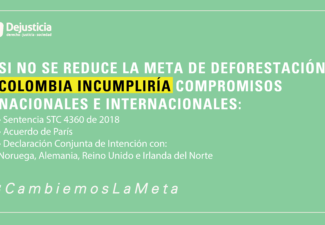
Join our Petition in Change.org: We want zero deforestation in the Amazon
By Dejusticia |
We, the 25 children and youth who won the first case in Latin America involving climate change and future generations, met with experts and civil society organizations in Colombia to ...
Lea más 
#LetsChangeTheGoal: We ask for a change in the deforestation target proposed in the National Development Plan
By Dejusticia |
Last March 5, 2019, the youth plaintiffs in the writ of protection (tutela) case involving climate change and future generations met with experts and civil society organizations to submit a ...
Lea más 
Leading Human Rights Organizations Support a Democratic, Non-Violent Solution to Venezuela’s Crisis
By Dejusticia | | Estados Unidos, Gobierno, Iván Duque, Venezuela
On January 23, Venezuelans took to the streets in massive numbers, rejecting Nicolas Maduro’s claim to a new presidential term based on an illegitimate electoral process, and supporting an end ...
Lea más Search in Opinion
I don’t care if they call me a dictator.
By Nina Chaparro González | | bukele, Democracy, Dictadura, El Salvador, Program for strengthening - Others
During his six years in office, Bukele has consolidated his power, paving the way to become the dictator he appears to be announcing himself as.
Lea más NGOs at risk of global extinction
By Nina Chaparro González | | financiación internacional, NGO, Program for strengthening - Others
How can non-governmental organizations transform themselves? What were they like when they did not depend on international funding?
Lea más Colombia: going back to the original balance of justice
By Paola Molano Ayala | | gorillaz, JEP, Transitional Justice, Victims
There is a crucial aspect of Colombia’s transitional justice model that is worrying: the current inability of the Special Jurisdiction for Peace (JEP) to offer legal security to those who participated in the conflict, including in human rights violations, and have not been identified as among the most responsible. And making sure they also contribute to the satisfaction of the rights of the victims. The JEP must avoid keep moving towards maximalist approaches and go back to the balance in the Peace Agreement.
Lea más
Stories
FromTheTerritory
We travel with 20 indigenous activists of the world to the heart of the Sierra Nevada de Santa Marta. Listen to this story about the Kankuama Resistance.
Dejusticia's
Documentaries
Discover some of the documentary pieces that we have made. Indigenous resistance, migration of Venezuelans to Colombia and stories of women coca growers, are some of our topics of interest.
